Influence the Media has on the Publics Perception of Wildlife

This essay, from my University course a few years ago will look into the forms of medium that, from a personal perspective, has influenced the public attitudes towards wildlife and nature. The media is found to use stereotypes to appeal to a target audience, and it does this by enhancing a character’s features and playing upon them. It will show how anthropomorphized characteristics of an animal can bond to an audience. The history of stereotypes and how perceptions have changed over time will also be explored. 

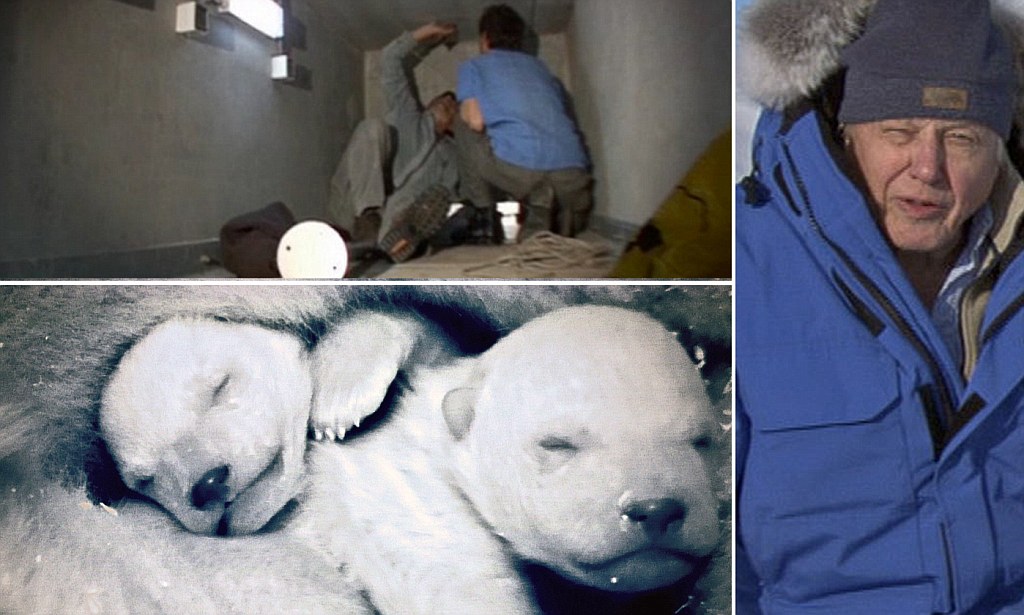
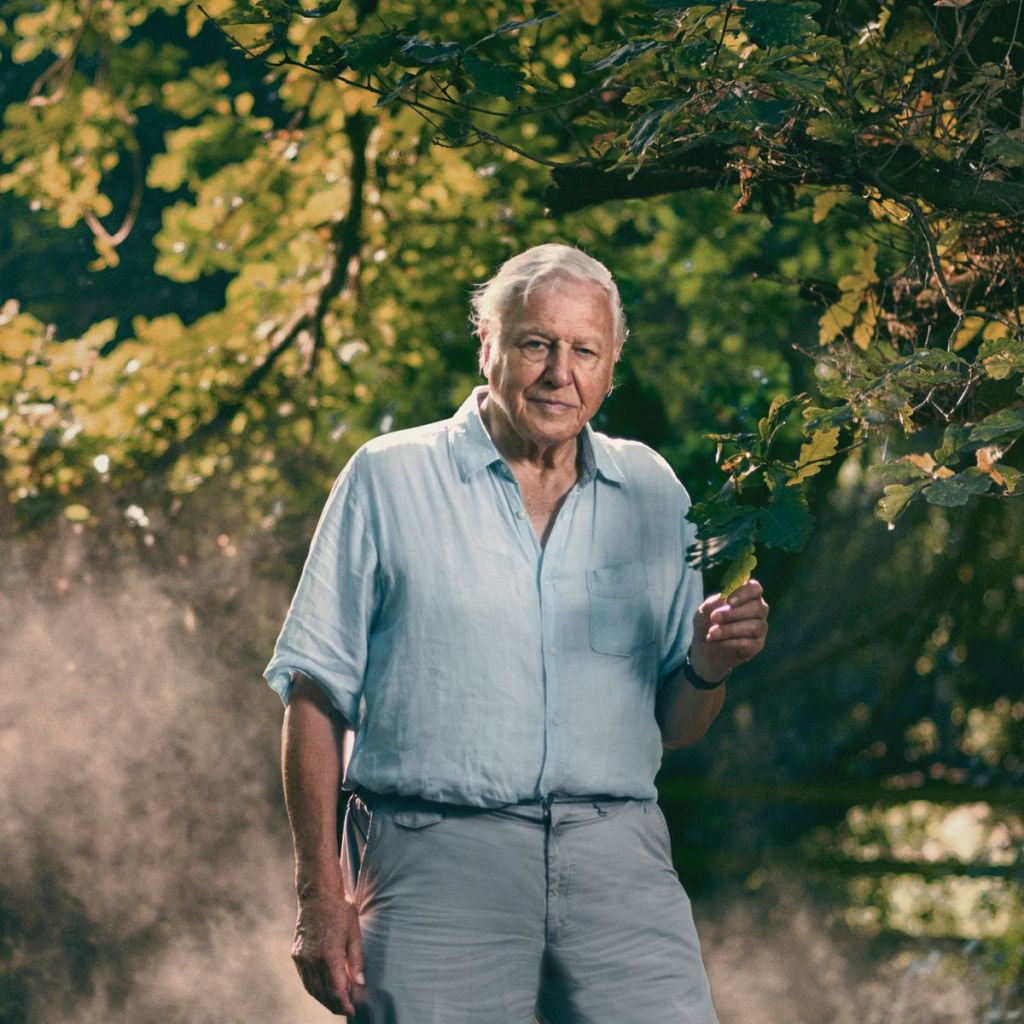
Natural history plays a key part in how wildlife is represented; as film producer, Richard Brock says, “It’s a good subject”, (Brock, 1995) meaning the ideologies it carries are interesting for a broad audience. Humans are becoming increasingly separated from the natural world, and nature-based wildlife media offers a way to regain some form of connection, for example BBC’s ‘Life’, with David Attenborough. We expect to see something enthralling maybe as a means of escaping from our everyday life. We like seeing things that are rare and unusual, (Bousé, 2000). Bousé (2000) states that the footage you see in wildlife films has been shaped into what the audience will find interesting. Which makes sense, as it would be tedious to watch an un-inspirational film. 

Image Credit BBC Sam Barker

“If you watch animals objectively for any length of time, you’re driven to the conclusion that their main aim in life is to pass on their genes to the next generation”. – David Attenborough

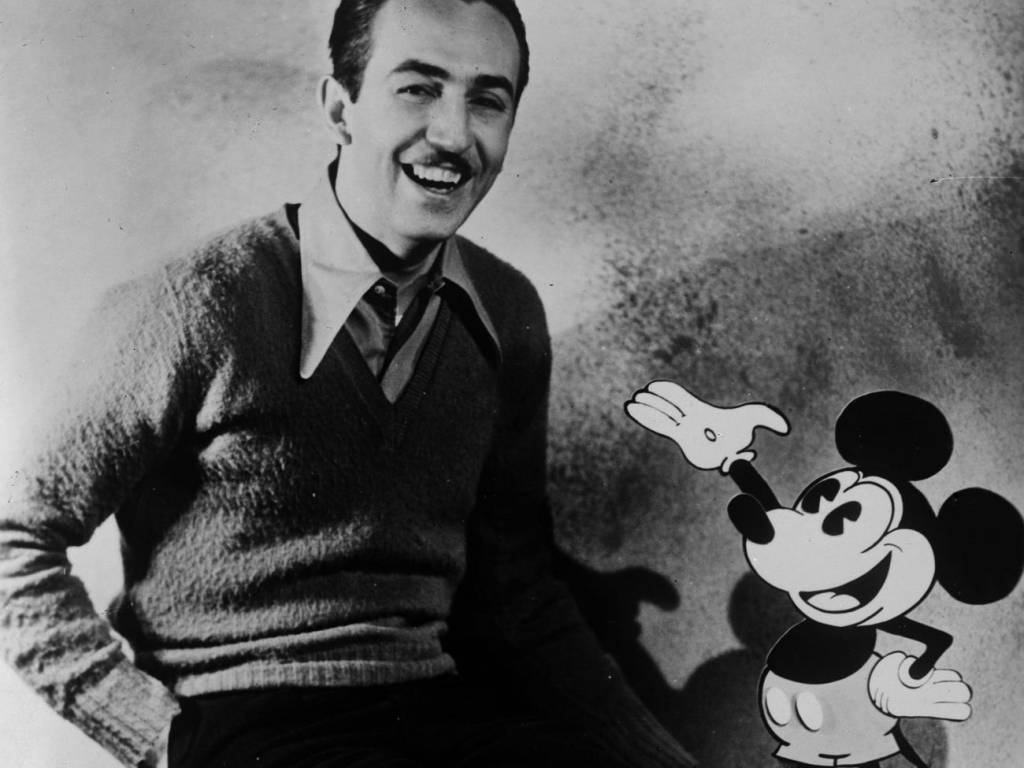
Our modern day interpretations of animals are down to two main men; Marlin Perkins and Walt Disney (Davies, 1997). Mitman (1999) says that Disney represents the ideal family through animals. Where Disney started with his longer films aimed at children, Perkins created television programmes that show the domestication of these previously seen animals, for example, ‘Zoo Parade’ (1950-57) whose message was to appreciate the animal kingdom and ‘Wild Kingdom’ (1963-82). Mitman (1999) says that Perkins expanded upon Disney’s work. This is an interesting phrase, as the ideologies are perceived differently, yet both give animals a sense of anthropomorphism. 

Credit: General Photographic Agency / Stringer

“Movies can and do have tremendous influence in shaping young lives in the realm of entertainment towards the ideals and objectives of normal adulthood.” – Walt Disney

As seen in this clip (see link 1) Perkins has visited the countries that Disney portrays in the early films. The audience ‘knows’ from previously seen medium that the alligator is a dangerous animal that then makes the men in the clip above look very ‘manly’ when strangling it to get it out of the water. If broadcast now this would end in many lawsuits and animal right complaints, and not only is the alligator perceived to follow its stereotype, but man tries to show off his testosterone levels too.

This clip (see link 2) is a rather interesting episode of ‘Wild Kingdom’ (1960+) by Perkins. Its focus is on the myths and superstitions the public have towards animals. Perkins uses staged experiments to find out whether they are true. For example, are elephants scared of mice? In this clip of ‘Dumbo’ (1941) (see link 3) at minute 21.23 Disney uses the mouse perfectly when scaring the elephants. This has shown a development of awareness about animal behaviour in a short space of 20 years. 

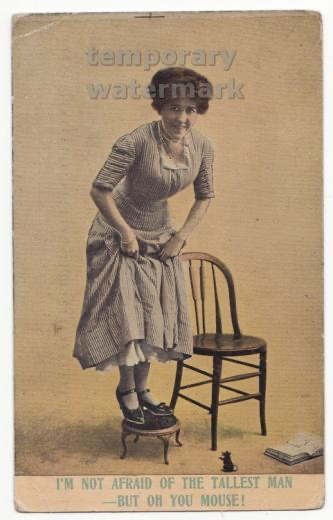
There is also a use of binary opposites in this film of Dumbo making friends with the mouse and the older female elephants being scared of him, thus portraying anthropomorphic behaviour. It is stereotyped that humans perceive mice as scary as seen in this poster of a housewife. However there is no evidence that a mouse has ever killed or eaten a human… or elephant for that matter.

(Inkfrog, n.d.)

According to Bignell (2002) the dominant ideology of society changes with the economic and political conversions. Thus media plays the main role when developing the public’s views on a species, including though television, newspapers and fiction. It allows a vast range of knowledge to be available from all over the world without leaving the house. It can then develop the public’s understanding of any socioeconomic and political problems that affect a species and their natural habitats. 

Without a variety of medium, the effect we are having on the world would go unknown. For example, the effect of plastic pollution, as seen in the images below, animals mistake these for food and can die of strangulation or suffocation. Strong images can play a key part on the public and motivate them to make a change. 

(Greatpacificgarbagepatch, n.d.) 


  (Straight, n.d.)

Philippon (2002) says, each of Disney’s films has an ecological and social conservative ideology that you particularly see in ‘The Lion King’ (1994). This clip from ‘The Lion King’ (see link 4, 6 seconds in) is where the female needs the males help to escape the hyenas, who are portrayed in a negative light throughout the whole film. In order for Disney to sell his ideologies to the audience he will need to act upon an already established stereotype. Here he is using the damsel in distress to provide a ‘function’ for the male character. A theory originated from Vladimir Propp – every character has a purpose. 

It was Walt’s drive for perfection that sold his stories, (Finch, 1995). Persuasion involves shaping, response reinforcing and response changing and this can be applied to how the stereotypes of animals in the Disney films are shown. Perception management conveys selected information in order to influence the audience’s motives and emotions towards the certain species, (Balnaves, et al 2009). If Disney’s message was motivated to such a degree that it leads to the audience processing it deeply then the perception of an animal will lead to a lasting change, (Petty and Cacioppo, 1986). In this context, stereotypes can be effective. 


Let’s do things in the proper way and try not to save a penny here and there” – WaltDisney

A strong technique to unite an audience to a film is to produce an infant, as seen in ‘The Lion King’. The audience then feels a part of that characters life; they like to see how he develops into an adult as it brings out a maternal instinct that engages the audience. The public will have empathy towards an animal if it is representative of something important to them. Lions are seen as majestic and patriotic to the British and are seen in our coat of arms. In the Lion King, lions are the protagonists and hyenas play the antagonist.

The audience perceives certain ideologies depending on the filmmaker’s aims and objectives. The characters have been represented in a way that appeals to the target audience be it simple stereotypes or complex representations of a character (Bennett, 2005). Character can mean an animal, an ecosystem or place. If the filmmaker wants empathy from the audience he will create a character that includes these basic features; a softness in facial expressions, big eyes giving a sense of vulnerability, and small in size when compared to others. According to Kelly (2010) the higher abundance of features the advertisement has, the more successful will be. 

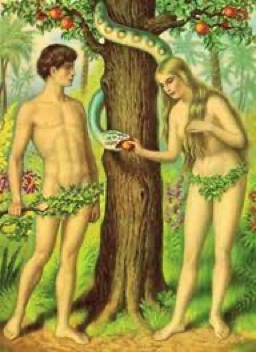
The audience is guided to believe the media’s own codes and conventions. If an animal is portrayed in a negative way, and is established at an early point, both in the film and in the audiences life, any future feelings of that given animal will be associated with that first experience. ‘The Jungle Book’ (1967) uses stereotypes perfectly. A main stereotype developed from early years includes the snake, represented negatively because of the bible. A more recent example is this clip of Kaa (see link 5) trying to eat Mogli, representing snakes perfectly in a negative light.

(Bahaisofutah, n.d.)

Disney had strong religious beliefs and they are seen throughout his work. He was even named after the local preacher, Walter, his father’s good friend (Thomas, 1994). He portrays high morals in each of his films; they can particularly be seen in ‘Bambi’, ‘The Jungle Book’ and ‘Snow White’. ‘Bambi’ (1942) represents a key figure and influences the audience’s perception on deer (Lutts, 1992) and at such a young age the audience are very passive to accepting ideologies.

Stereotypes give the audience an automatic perception of that animal’s behaviour and characteristics, reinforcing their perception of the natural world and the species within, (Jowett and O’Donnell, 2006). They thrive because they are based on a grain of truth and over re-presentation in the media. It is easier to relate a negative behavioural concept with an animal or human than it is with a positive, as you see with vultures scavenging or Pitbull terriers biting, or Doberman dogs being fierce. There has however been a development in the media that plays upon these stereotypes of certain animals, and this is now done for a comedic effect, as seen in this link (see link 6) from the film ‘UP’ (2009). The ‘Alpha’ Doberman dog has high pitch voice, and works because the audience expected a deep one. 

However, a prejudice is more an attitude and harder to change than a stereotype that could be molded over time. The public has a negative attitude towards sharks, because of the strong portrayal of the 1975 film ‘Jaws’. Watching and listening to this trailer, (see link 7) the audience doesn’t have the opportunity to think anything other than a negative thought. This is an example of the hypodermic needle theory in practice, where an ideology is fed into the passive audience, (Bennett, 2005). However if aimed at an active audience then the two-step flow concept comes into play, and this can be applied to documentaries. Where the topic at hand is received by an active audience and ideologies acted upon, for example, with conservation documentaries, it influences the audience to care a little more and possibly make a change in their lives.

When the media uses strong images as seen in the film ‘Jaws’ it is those strong images that can change ones perception on a subject and / or character, mainly negative from this film. A wildlife documentary however, can provide a healthy understanding of a lesser-known animal and it can raise awareness and learn about the animal’s characteristics. It can change this one way, with intimate close up shots of eye contact; showing a mother and baby together will work too, Bousé (2003). 

Public perception of a species can change. Images and characters that represent freedom, patriotism, safety, prosperity and happiness will be beneficial for a medium to use and sell its ideas. The government could utilize them in a positive way, thus the public should have confidence in the message being portrayed. So for example, the Gray Wolf went from a dangerous antagonist in films to a loyal symbol of patriotism in America. Two very different attitudes all developed because of the media’s portrayal. 

(Kitaro, n.d.)
(Villains, n.d.)

There are many animals that have had scientific research carried out and they have been found to be highly intelligent and sociable as seen in cetaceans for example. Many centuries ago and still in some countries today, it is socially acceptable to hunt them yet the media has helped protect and conserve them. 

There have been many influential films such as ‘Flipper’ (1963) that have shown dolphins in a positive light. Ric O’Barry who used to capture dolphins helped with the 2009 documentary film ‘The Cove’ (see link 8 – trailer – nb please be aware, that link has disturbing footage) with the aim to make the public aware of what was happening in the Japanese fishing industry. This powerful film shows what the Japanese do is very unethical and cruel. The public perception from this film should encourage the audience to care about what they eat and create a movement to hopefully shut down this sort of ‘fishing’.

Kirkwood & Hubrecht (2001) state the media can affect an audience’s point of view on occurrences such as those shown in ‘The Cove’. Conservation methods are developed, based upon people having a keen interest in understanding why a species need to be conserved and the public attitudes and opinions have been influenced by what they see in the media. 

The filmmaker behind a wildlife documentary will have an agenda and hopefully the audience will absorb the information being represented and act upon it (Serpell, 2004). As well as the explicit ideologies portrayed there will be implicit ideologies within the text; this could add a variety of aspects to the narrative. If a filmmaker were to leave out an important aspect of a story then that could bring up certain questions, depending on whom it affects. For example an animal might be great at hunting but its key characteristic that it is known for is it’s ability to run then it will be portrayed as a fast runner, as seen with Cheetahs (Snaddon, Turner, and Foster, 2008).

The majority of the public care about animals, yet in todays busy schedule ‘animals’, as a collective term, might not be at the top of their list of priorities. The Government is expected to provide services to address the needs of society; in many ways the media influences what society requires. The Government will consider the needs of the public depending on social, economic and environmental factors and act upon what is seen as the most important. Thus, the media can determine what the public perceive as important. It will do this by acting as an opinion leader, (Bennett, 2005). It is these ideologies that might spark a public reaction and therefore create an appeal that will then get noticed by the Government and create a spark to make a change (Kelly, 2010). This is one factor that has led to wildlife documentaries becoming so popular. 

 (WWF, n.d.) 

There has been research into a study by Ms. Wong-Leonard (1992) about a child’s perception of an animal, and why. Their knowledge was from what they watched throughout their childhood, such as ‘Sesame Street’ and other cartoons (Cea, 2010). Disney played a key part here too. The film ‘Bambi’ (1942) gave a somewhat realistic scenario to children about animals in their natural habitat and portrays man as the villain (Booker, 2009). It develops an interest at an early age about nature and the animals that live in the ‘wild’ and will lead the children to gain an interest in wildlife documentaries as they get older.

The David Attenborough series document the beauties of the world and enlighten people to care a little more. The main purpose of a wildlife documentary can vary, depending on the order of ambitions. Its main priority could be to educate, then to encourage a movement and finally to entertain and this order varies between programmes. This will depend if it’s from a well-known institute whose job is to provide the public with a level of educational programmes like the BBC, or a Channel 4 independent company produce solely to entertain.

Wildlife documentaries have represented animals for the last 100 years, and the means of how they are portrayed has developed as the science has developed too. A better understanding of behaviour is seen and the audience learn the reasons as to why they do this, for example the courtship ritual of a male bird, (see link 9). 

Over the last 100 years, the relationship people have with the natural world has changed. It has divided into three directions – urbanized areas, farmland and a small percentage natural. The media is a tool to educate, entertain and inform, (Bennett, 2005) ironically, at the same time the media is being abused and direct exposure to the natural world is being lost. Children are spending more time indoors utilizing a variety of medium whilst the open fields and surrounding woodland are being forgotten. 

The media portrays a mix of implicit and explicit ideologies that the audience will subconsciously be fed and it is these that are developed upon in the audience’s lifetime by them being repeated throughout the years and spreading through the genres. With most of us, it began with Disney.

As scientific research methods have developed, the media has moved from representing animals for entertainment, and become a perfect tool to educate. As a result of advances in filming equipment in the last 13 years there has been an interesting change towards a more aesthetical approach. 

Most animals are now portrayed more equally than before, as a whole they are together fighting the battle against climate change and global warming. They all have one common “enemy” and that is us humans; this is a concept seen through the media. The media therefore is the tool that can create a difference; it can encourage the audience to, for example reduce, reuse and recycle and develop conservation techniques. 

With the public gaining a clearer understanding about the effect they are having on Earth as an ecosystem and how it is affecting the wildlife, there should be a developing movement towards helping recover and conserve the species of critical numbers. It is up to the media to sell fair representation of the natural world to the public in order for a wholesome decision to be made on their behalf as to what steps should be taken. 

The path wildlife documentaries will take over the next 20 years is likely to be an innovative and exciting process and one that is of high interest. After being brought up surrounded by nature it only comes naturally to share thoughts and beliefs to enlighten others to see the natural world for themselves.

To be part of how the future generations perceive and understand the natural world would be an area I am keen to learn about, and to create a career within. Not only broadening my own ambitions but enhancing those of others and motivating a movement.

Link References 

  1. Mutual of Omaha’s Wild Kingdom, 1963. Unwelcome Help. Available at: <http://www.youtube.com/user/WildKingdomTV&gt; [Accessed 17 February 2013].
  1. Mutual of Omaha’s Wild Kingdom, 1963. Myths and Superstitions. Available at: <http://www.youtube.com/watch?v=RmQLkfPJB_Q&gt; [Accessed 17 February 2013].
  1. Dumbo, 1941. Full Movie. (Greek Audio) Available at: <http://www.youtube.com/watch?v=kwDQdSTUvUw&gt; [Accessed 17 February 2013].
  1. The Lion King, 1994. Hyenas Chasing Simba. Available at:  <http://www.youtube.com/watch?v=x49NwjnwDUw&gt; [Accessed 17 February 2013].
  1. The Jungle Book, 1967. Mogli and Kaa’s First Encounter. Available at: <http://www.youtube.com/watch?v=nTjcrNAp4DI&gt; [Accessed 17 February 2013].
  1. UP, 2009. Dogs Talking. Available at: <http://www.youtube.com/watch?v=zfDhaPO_NL4&gt; [Accessed 17 February 2013].
  1. Jaws, 1975. Trailer. Available at:   <http://www.youtube.com/watch?v=ucMLFO6TsFM&gt; [Accessed 17 February 2013].
  1. The Cove, 2009. Trailer. Available at: <http://www.youtube.com/watch?v=4KRD8e20fBo&gt; [Accessed 17 February 2013].
  1. BBC Planet Earth, 2009. Bird of Paradise. Available at: <http://www.youtube.com/watch?v=A-05Z-GsGfI&gt; [Accessed 17 February 2013].

References 

Balnaves, M., Hemelryk, Donald, S. and Shoesmith, B., 2009. Media Theories and Approaches – A Global Perspective, Palgrave Macmillian.

BBC, 1995. Interview Richard Brock, interview date: 15 June. [online] Available at: <http://eprints.ucl.ac.uk/5188/1/5188.pdf&gt; [Accessed 15 February 2013].

Bennett, J., 2005. Media Studies. Pearson Education Limited. 

Bignell, J., 2002. Media Semiotics- An Introduction, 2nd ed, Manchester University Press, Pg 25. 

Booker, M. K., 2009. Disney, Pixar, and the hidden messages of children’s films, Santa Barbara, California

Bousé, D., 2000. Wildlife Films, Philadelphia: University of Pennsylvania Press

Bousé, D., 2003. False intimacy: close-ups and viewer involvement in wildlife films, Visual Studies. [online] Available at: <www.tandfonline.com/doi/abs/10.1080/14725860310001631994#preview> [Accessed 6 February 2013].

Cea, J., 2010. Children’s Perception of Wildlife, [online] Available at: <http://blog.timesunion.com/wildlife/children’s-perception-of-wildlife/345/&gt; [Accessed 5 February 2013].

Davies, G., 1997. Networks of Nature: Stories of Natural History Film-Making from the BBC, University of London.
Finch, C., 1995. The Art of Walt Disney, Virgin Publishing Ltd.

 Jowett, G.S. and O’Donnell, V., 2006. Propaganda and Persuasion, Sage: London.

Kelly, D., 2010. Which comes first- the animals, the media or the public expectation? [online] Available at: <http://www.daff.gov.au/animal-plant-health/welfare/aaws/aaws_international_animal_welfare_conference/which_comes_first-_the_animals,_the_media_or_the_public_expectation&gt; [Accessed 15 February 2013].

Kirkwood, J. and Hubrecht, R., 2001. Animal consciousness, cognition, and welfare, Animal Welfare [online] Available at: <www.ingentaconnect.com/content/ufaw/aw/2001/00000010/A00101s1/art00002> [Accessed 7 February 2013].

Lutts, R. H., 1992. The Trouble with Bambi. Walt Disney’s Bambi and the American Vision of Nature, Forest & Conservation History. 

Mitman, G., 1999. Reel Nature: America’s Romance with Wildlife on Film, Cambridge, MA: Harvard University Press.

Petty, R. E. and Cacioppo, J.T., 1986. The Elaboration likelihood model of persuasion, Advanced Experimental Psychology.

Philippon, D. J., 2002. Nature on Screen. [online] Available at: <http://www.tc.umn.edu/~danp/nature_on_screen.pdf&gt; [Accessed 15 February 2013].

Serpell, J., 2004. Factors influencing human attitudes to animals and their welfare, Animal Welfare, S145-S151. [online] Available at: <www.ingentaconnect.com/content/ufaw/aw/2004/00000013/A00101s1/art00021> [Accessed 6 February 2013].

Snaddon, J., Turner, E., and Foster, W. 2008. Children’s perceptions of rainforest biodiversity: Which animals have the lion’s share of environmental awareness? [online] Available at: <www.plosone.org/article/info:doi/10.1371/journal.pone.0002579> [Accessed 6 February 2013].

Thomas, B., 1994. Walt Disney: An American Original. Hyperion: New York.

Photograph References 

  1. Lady standing on chair, n.d. [image online] Available at: <http://img.inkfrog.com/click_enlarge1.php?image=2214JED_f_10-afraid-of-mouse_int.jpg&username=marale2002&aid=670108746&gt; [Accessed 17 February 2013]. 
  1. Plastic bag jellyfish lookalike, n.d. [image online] Available at: <http://greatpacificgarbagepatch.blogspot.co.uk/&gt; [Accessed 17 February 2013].
  1. Turtle eating plastic, n.d. [image online] Available at: <http://www.straight.com/news/waves-disaster>&nbsp; [Accessed 17 February 2013].
  1. England Coat of Arms, n.d. [image online] Available at: <http://resources.woodlands-junior.kent.sch.uk/customs/questions/motto.html>&nbsp;   [Accessed 17 February 2013].
  1. Rafiki holding Simba, n.d. [image online] [Accessed 17 February 2013]. 
  1. Adam and Eve and the Snake, n.d. [image online] Available at: <http://bahaisofutah.angelfire.com/GARDEN.html&gt; [Accessed 17 February 2013].
  1. Gray Wolf, n.d. [image online] Available at: <http://www.kitaro10.com/artwork/photography-artwork/incredible-wild-life-photographs-inspiration/&gt; [Accessed 17 February 2013].
  1. The Big Bad Wolf, n.d. [image online] Available at: <http://villains.wikia.com/wiki/Big_Bad_Wolf&gt; [Accessed 17 February 2013].
  1. WWF, n.d. [image online] Available at: <http://theglobalcause.blogspot.co.uk/2011/04/blog-post_12.html&gt; [Accessed 17 February 2013].

Bibliography

Share the Sky, 2012. Save the Vultures, Available at: <http://www.share-the-sky.org/index.php/news&gt; [Accessed: 14 February 2013]. 

The British Monarchy, n.d. Swan Upping [online] Available at: <http://www.royal.gov.uk/royaleventsandceremonies/swanupping/swanupping.aspx&gt; [Accessed 14 February 2013].

The benefits of camping

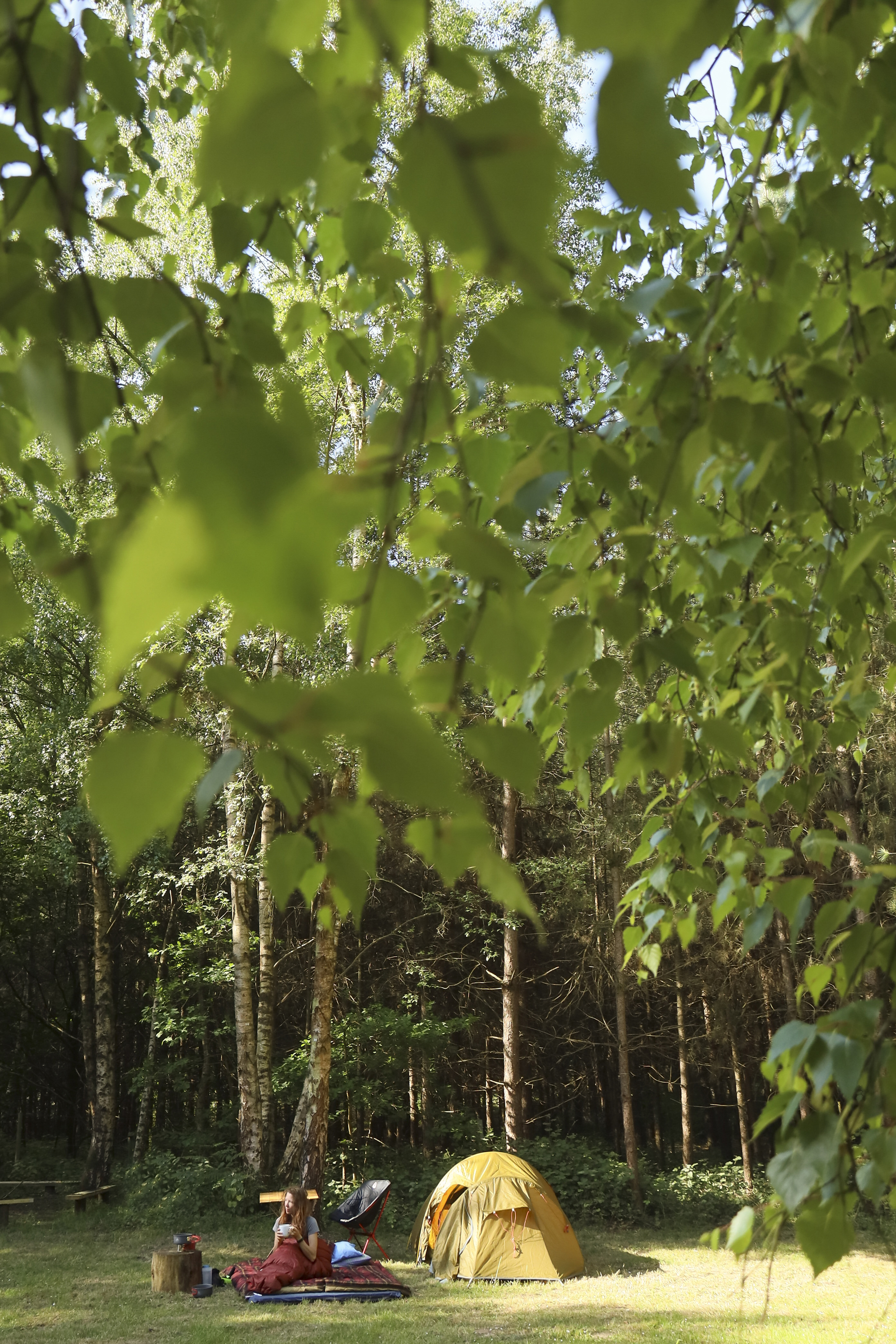
If I think about why I love camping, the answer is pretty simple. Camping means you are closer to nature, you experience the world in a totally different way. When you camp, you can feel the temperature drop, you know when it is about to rain, you get used to the wildlife that surrounds you and you notice every single change. It is only when you are continuously out in nature that you see first hand what is happening in our environment, no matter what landscape you are in, and it is not all good…

If everyone took time out to go camping, whether it is on a small site or in the ‘wild’ then I believe people would have a much better understanding of the natural world and therefore a desire to protect it. I think that DofE should be mandatory, and in times like these the government should be supporting outdoor centres around the country keeping them open. But instead the outdoor industry is providing no jobs and staff are being made redundant left, right and centre.

We need to help keep the youngsters of today connected to the world and what better way to do so than camping.

Why I love the Lake District

Lake District

For as long as I can remember I have enjoyed the great outdoors. I loved the difference in weather, I loved meeting different people and of course the different views each day brings. What better place to get all of these things in one place than the Lake District. Mike and I met in the Lake District over 10 years ago and every time we go back we find some new route to go and explore. However there are things that we do time and time again. We go to the Picnic Box in Ambleside and order rocky road – it is the best you have had! We have brunch in the Apple Pie shop, again more scrumptious pie that is pretty darn good. The sticky toffee pudding in the Wainwright Pub in Langdale needs to be tested out too. This blog is should be called my favourite Lake District food!

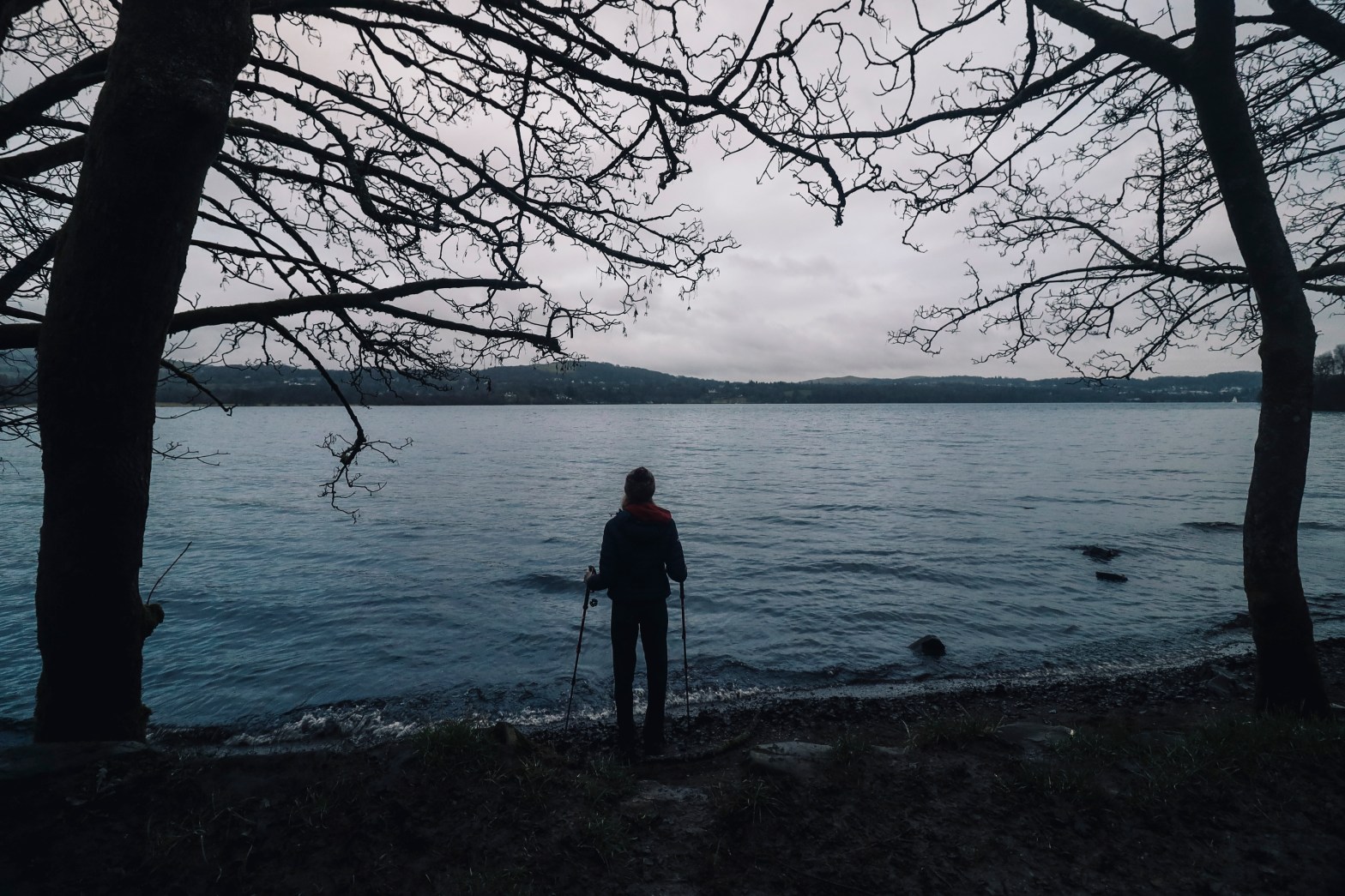
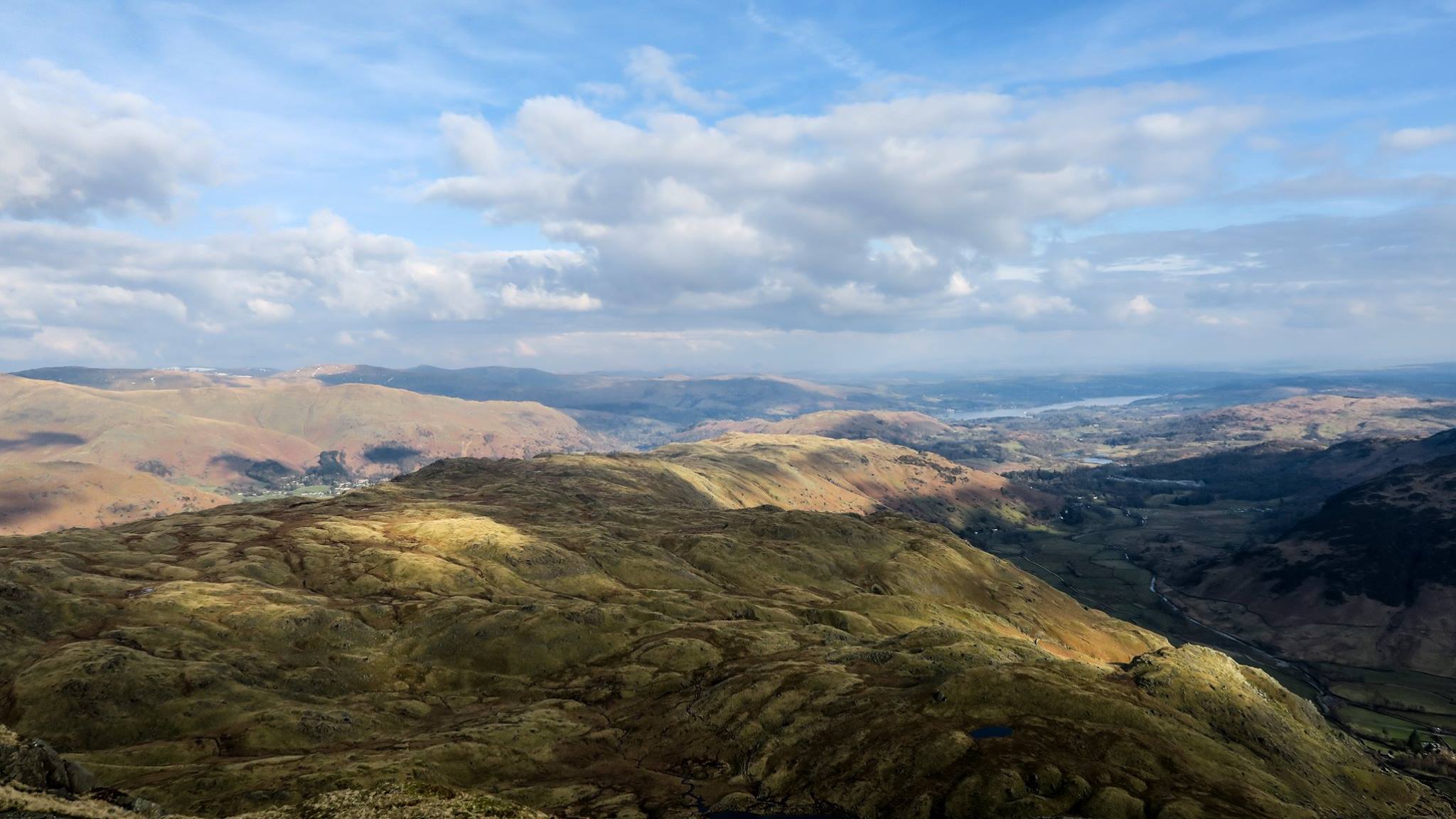
Some of my favourite walks are around Coniston, including the Old Man. I enjoy walking the Langdales and I do love a good climb up to Stickle Tarn, then weather dependant nipping up to Pavey Ark as the views from there are some of my favourite. I have started to use walking poles now, not only do they help my knee on the way down but they are lightweight so are no extra effort to carry. You can buy some great gear on the top floor of the Epic Centre, also we love a good look around Adventure Peaks, who also have a climbing wall incase the weather outside is pretty bad. There are loads more things I love about the Lake District but I will share them another time! Ciao for now!

Supporting Artist – Background Extra

Why do we need to protect Ancient Woodland?

We know that trees are home to such an array of wildlife and we already know that being amongst them is good for our mental health, but all that aside, and apart from the fact they create oxygen, why should we protect them?


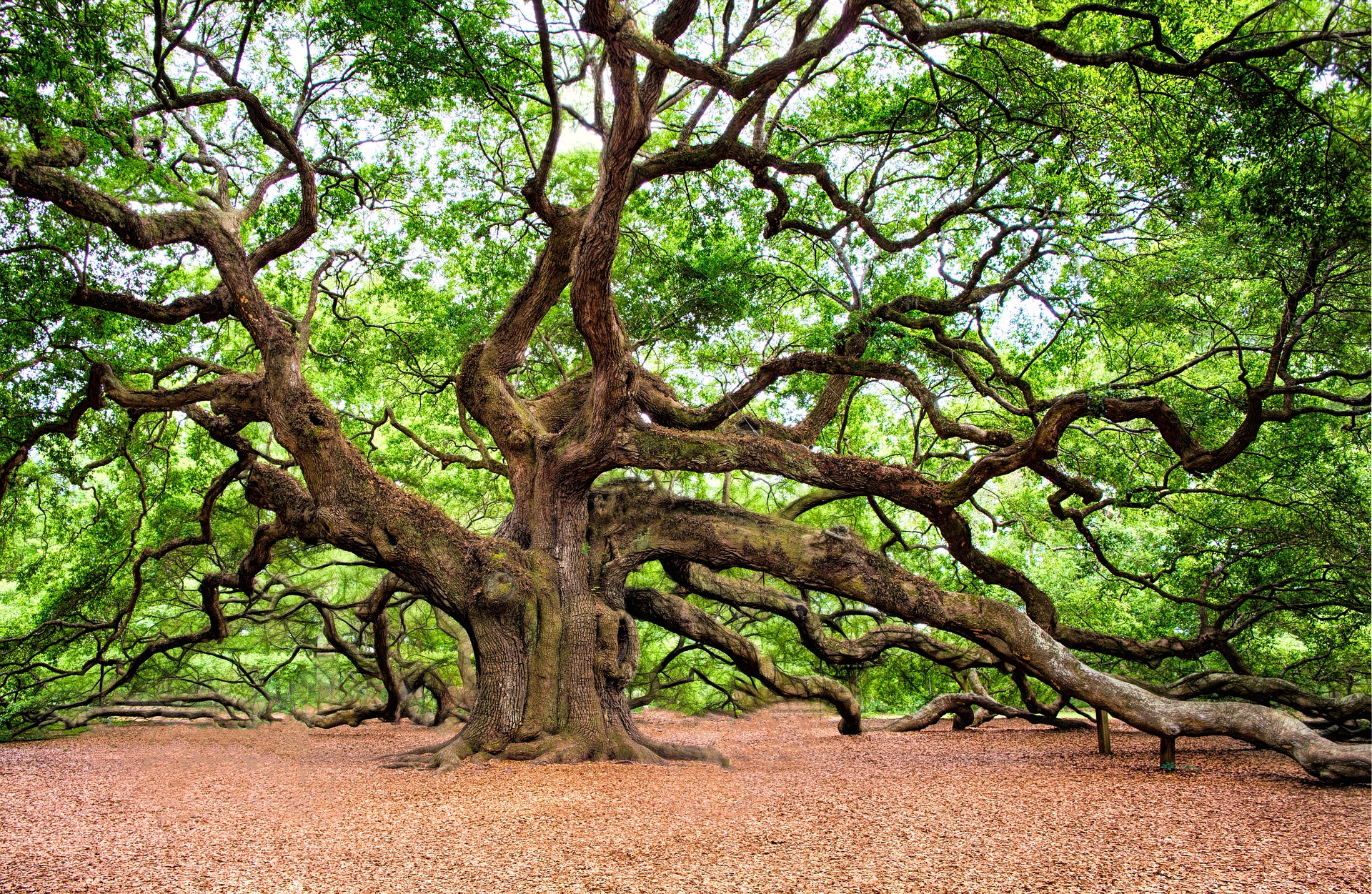
Trees are the lungs of the earth, they are all interconnected, they talk to each other in their own special language. Next time you are out, turn your phone off and just place your hands on a tree, any tree, the gnarlier the better. Close your eyes and just breath. Once you are there, don’t worry if any one is looking, clear your mind of the every day stresses. Everyone in life has these – you are no different. But take this moment to just connect. I do this on every walk, normally with a hug and it really helps me be me.

Ancient Woodlands only started to be mapped out in England and Wales since 1600s and 1750s in Scotland and the earliest findings are in the Domesday book which was compiled in 1086.

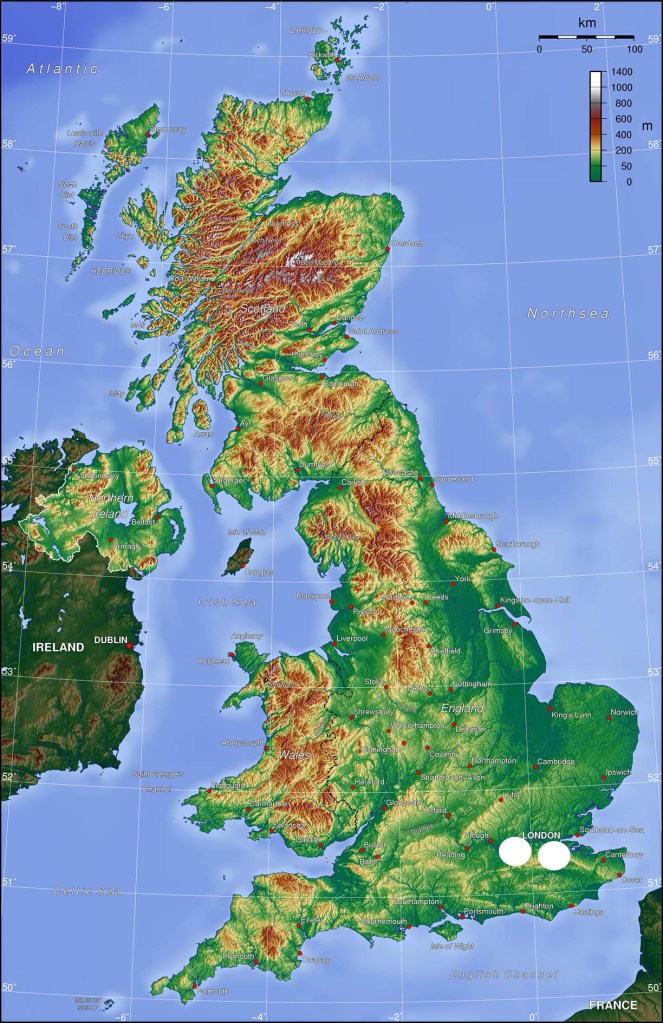
 These inventories show that 7% of ancient woodland was cleared around the 1930s and 38% has been replaced with plantations of non native species (probably a lot higher now). Our land is now only covered by 2.4% ancient woodlands, which is a scary number. A number which doesn’t even cover the Caingorms National Park, or which is about 2 times the size of London, pretty tiny… (estimated by the two white dots).

Now, whilst I fully support replanting native species throughout the country, this cannot support the current wildlife whose habitat is currently being destroyed in the UK on projects such as the HS2.

So what is an ancient woodland?

An Ancient woodland, or “old-growth forest’ for our American friends, I would describe as a complex home to many species from micro-organisms to deer, which all rely on each other.  Without one, they others cannot survive to their full potential. 

beautiful tree tops.JPG

Each individual tree is a habitat to the invertebrates, which feed the mice and shrews,  which in turn feed the owls. I found a great diagram of the food  chain online which explains how everything is connected. Without the leaf litter from the trees to feed the worms, the mice will go hungry and the owls will have to find their food (and shelter) somewhere else.  Or foliage gleaners like warblers feed directly on the trees. Or woodpeckers break into the decaying wood for their food – these ancient trees provide birds with more essentials resources than any other types of tree on the planet. 

Credit: igcse-biology-2017

Here is a list of great ancient trees to visit: https://www.ancienttreeforum.co.uk/ancient-trees/ancient-tree-sites-to-visit/

So what can you do? You can find advice in the links below if you are a:

General member of the public, Landowner or a Business owner

Plus – you can sign my petition to protect the woodlands from HS2 here.

Oh an a little bit extra…

Have you heard of a Phoenix Tree? 

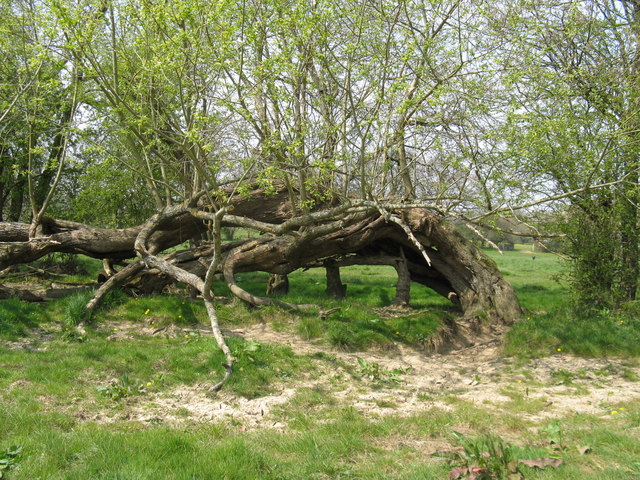
Ever seen a fallen tree with it roots still absorbing nutrients from the ground and the branches continuing to grow vertically? Well this is a Phoenix tree. A horizontal tree with it’s crown in the ground can create new roots and allow the old ones to decay. This regeneration is so important for the soil and the old branches can be left to protect the new growth so the tree can go on. 

So in conclusion, all ancient woodlands need our protection, the best way that we can do it is to educate ourselves about what it is that are damaging them and to work out ways every single one of us can do our bit. 

Phoenix Tree in West Sussex Credit: Dave Spicer

The North Pacific gyre and Ocean Pollution

In 1909

Bakelite is introduced to the Chemist Club in NY as the “first thermoset plastic,” meaning once formed, it was set for life.

In 1939

Nylon stockings debut at the World’s Fair.

In 1946

Earl S. Tupper produces a 7-ounce polyethylene tumbler, the first of many products available from Tupperware Home Parties, Inc.

There are now 5.25 trillion macro and micro-plastic pieces floating in the open ocean.

This is my presentation about the 5 gyres so please browse the slideshow above to find out more about these human made wildlife death traps.

Petition to save ancient woodlands from HS2

My petition is for the Government to “Review the route and construction plans for HS2 for environmental reasons.”

Current plans for HS2 involve the destruction of woodlands and use of unsustainable building materials.We want all ancient woodland left untouched and modern, environmentally friendly materials to be used, not materials like concrete.

This petition is not saying stop HS2, but is calling on the Government to review the route and construction plans for this project, because of the concerns of people who care about our environment and wildlife and we want to reduce the irreversible destruction to our ancient woodlands.

At 10,000 signatures, government will respond to this petition.

At 100,000 signatures, this petition will be considered for debate in Parliament.

Deadline 12 April 2021

#savethetrees🌳🌳🌳

Thank you. Holly.

Ancient Woodland in Cambridshire.JPG

Secret Suffolk

Being a Brega I am Suffolk born and bred. That doesn’t mean I don’t like to travel – I love exploring new places, but I wanted to share some of my favourite places with you,  these are my Suffolk Secrets. 

Boxted, Hartest and Hawkedon

These three villages are in the secluded Suffolk countryside, near Sudbury and I love them because I grew up in them. Boxted Hall can be rented out for family staycations. The Queens Head in Hawkedon is a great pub for an afternoon in the sunshine, or by the fire in winter. There are some great places to visit when in this neck of the woods, including Wool Towns like Lavenham, Kersey and Hadleigh. 

Here are some Suffolk places to stay near Sudbury…

1. Hylton Cottage, Lavenham 

2. Mulberry Cottage, Hadleigh

3. Ayres End Studio, Kersey

Moving towards the coast now and as we head to the east we get to another place where my family has a connection to. Walberswick, this old fishing village, now labeled as the most expensive place to buy a house in Suffolk (Aug 2020) is where we spent many family holidays crabbing. The whole area flooded in 1053 and that was when my Dad’s side of the family ran the pub, The Bell Inn. My dad had to be rescued by boat from the attic window at the age of 3. We still have the newspaper from that time. 

Here are some coastal places to stay near Walberswick…

1. Hex Cottage, Sibton

2. Flint Cottage, Wenhaston

3. Snow Hall Barn, Peasenhall

The most southernly area on my list now is Dedham Vale. Mike and I went to explore Constable Country a year or so ago and this area is very characteristic of Suffolk with its meandering river and lowland arable fields. A visit to here isn’t complete without visiting Flatford Mill, where John Constable painted one of his most well known pieces of art. 

Here are some lovely places to stay near Ipswich

1. The Presbytery, Colchester

2. Rose Barn, Stoke by Nayland

3. The Old Post Office, Higham

I hope you enjoyed reading about my favourite places in Suffolk. I will be following up with a second blog about my favourite places in the Chilterns and the Lake District. There are affiliate links in this blog, but all the places linked to are truly gorgeous. 

The DIY Vanlife Adventure

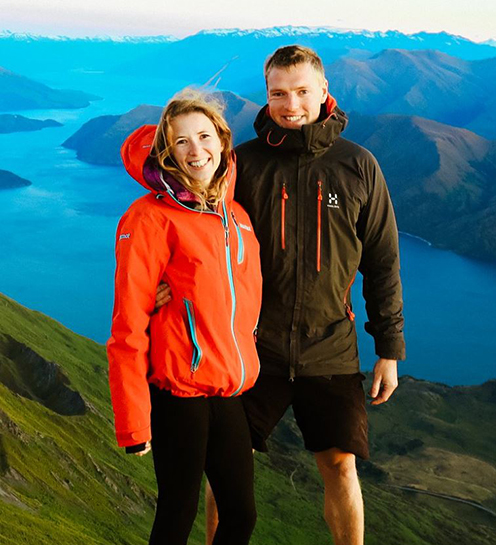
Welcome to Mike and Holly’s Vanlife blog. Here we will share our renovation stories, things we have learnt, found useful and that have gone wrong… Follow our story on Instagram here.
Stage 1 – buying

We had been keeping an eye on the market for a long wheel base since Autumn 2019. We had a great time testing out living in a van in New Zealand for 6 weeks the previous year (read blog here). So we knew 2020 was the year to make the leap.

We started looking for a van properly in March – just a Covid-19 approached and lockdown happened. That was when everyone was looking for a van as staycations were going to become more popular and people started delivery driving jobs. Vans soon became a rarity. After three months and hours scrolling through the internet we eventually found one! (We did find one sooner, but I wont bore you with the details, it had various things wrong).
Stage one realisations:

All garages will say they have that van coming in next week – they do not.

They say they will call you back – they will not.

That advert you see online isn’t of the exact van you are enquiring about – they just can’t be bothered to update the ad.

Stage 2 – windows

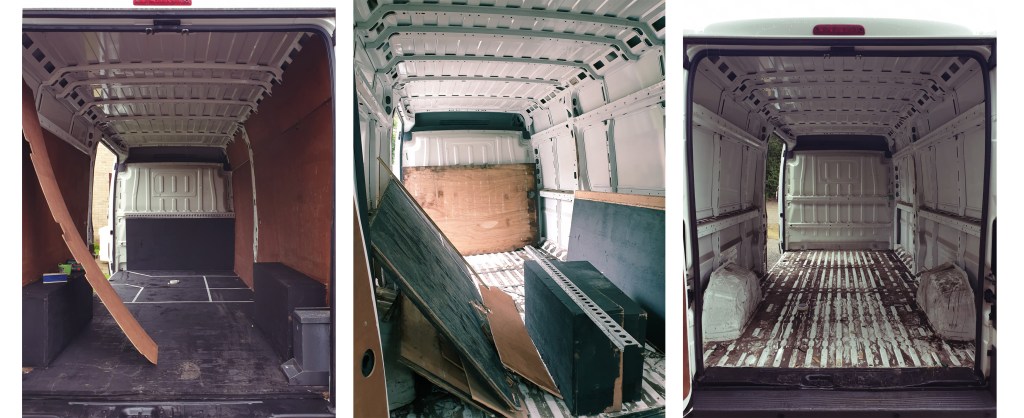
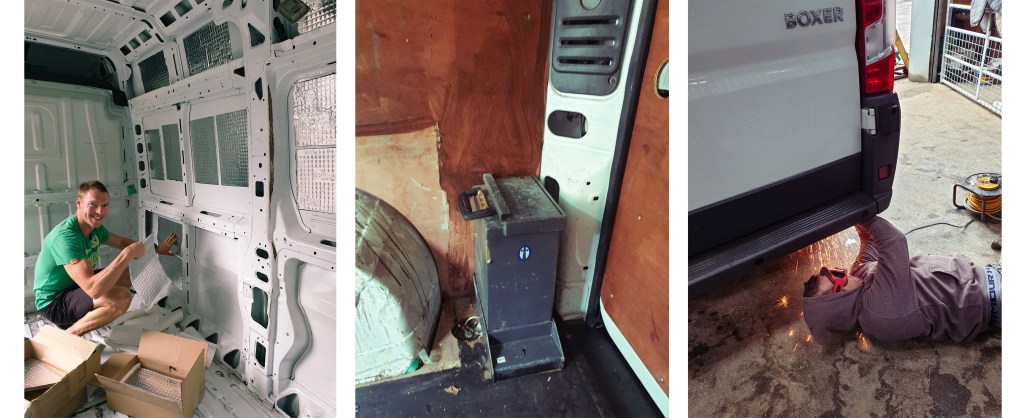
HPI checks complete and the van was finally on our drive, hooray! Our dream is now a reality. We have a set budget in mind and fingers crossed we stick to it. The first job was to sound deaden using Dodo Matting (you can buy it here) and take out the safe. We haven’t managed to open it yet – I wonder what is in there?!?!

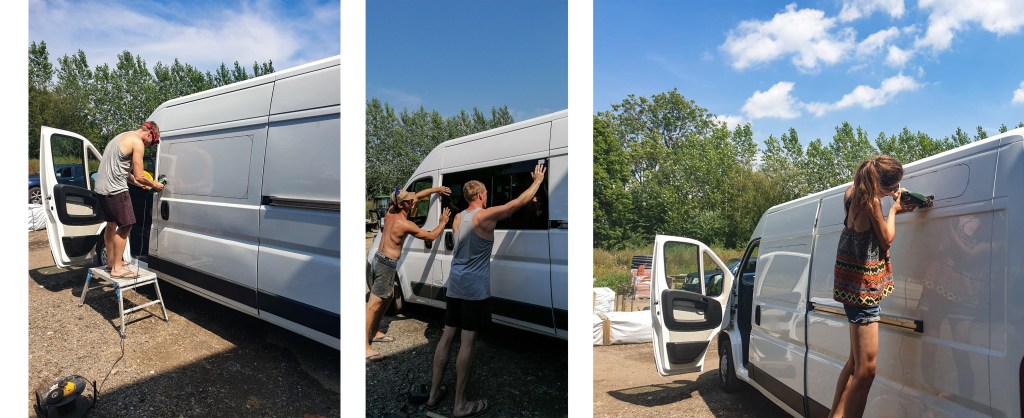
We took a while deciding where to buy our windows from, but eventually chose the website and brought the fitting kit with them. It was the simplest thing to do and also doesn’t work out that much more expensive. Josh, Holly’s brother was the first person to help us out! He, and his tools were amazing with getting the windows in.

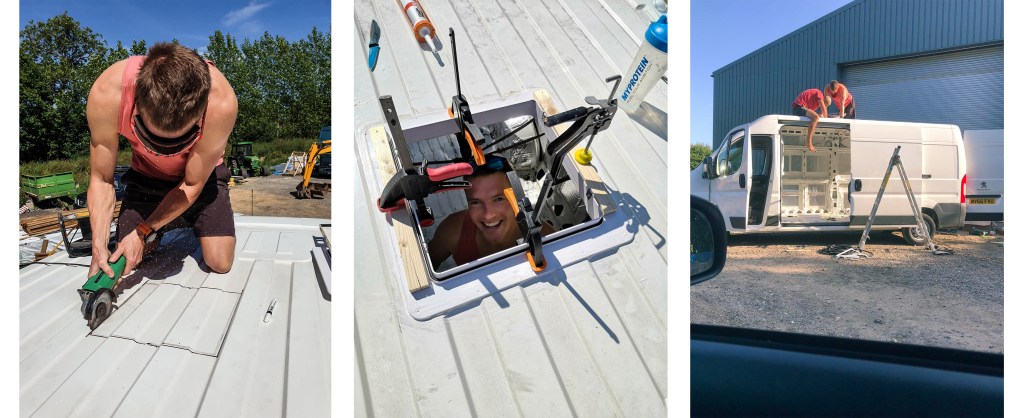
Our roof fan was the next thing to go in. We just wanted to get all the holes in the outside of the van cut as soon as possible, as you can’t move on with anything else until it is done. The fan we chose was a MaxxAir MaxFan Deluxe. We chose this because of the thermostat, remote and automatic features.

Stage 2 errors:

Make sure you clean off every teeny tiny bit of metal from cutting straight away, they will rust and are a pain to sort. We can’t stress this enough.

Don’t put the black primer too thick and wide onto the panels as you will see it once the window is on, and again, is a pain to hide.

Allow for the edging thickness when marking up the window cut lines, this will add an extra 6mm on (roughly) and will save you cutting it again!

Stage 3 – solar & battening

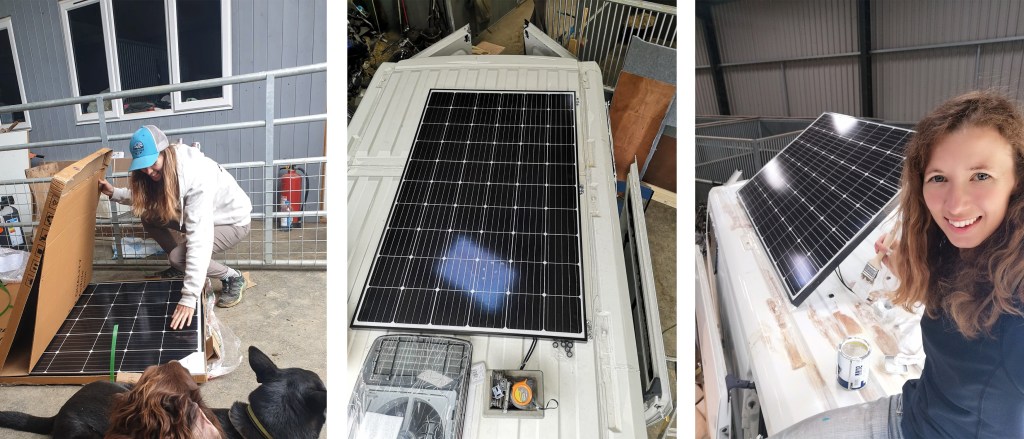
It took us ages to find the right Solar Panel. It was a large expense which we didn’t want to get wrong and have to send back. We finally found the one that was right for our set up. We needed it to power our usb sockets, fridge, laptop (via inverter) and that’s about it as the oven, hob and shower will be gas. We chose a Perlight 320 Watt Mono Panel. The white one was cheaper than the black so we went for that.

We decided we wanted our solar panel to be able to lift up, one because we could clean under it and second because if we were say, in north Norway then we could angle it to make the most of the sun! Just note that it didn’t come with cables long enough so that set us back a few days as we had to wait for new cables.

Here you will see that Holly is repainting all the specks of rust (after being painted with Hammerite Kurust, we mentioned earlier. It took ages and was a pain but hopefully it will work.

Battening was the next job at hand. We tried to use what the van had in terms of panels. We used self-drilling screws. Our friend Jen came to see us and help out. Thanks Jen! I am looking forward to getting family and friends involved in this build, as that is all part of it I guess.

Stage 3 realisations:

We didn’t make too many mistakes at this stage actually but we did learn that having nice weather makes this process so much easier! We have now ordered our insulation for the next stage. Oh, and we have just brought the fridge. Exciting!

Stage 4 – electrics & insulation

So before the insulation could go up, we had to wire in the electrics. This is something that neither of us have experience in. We decided to crack on and buy the wiring and put it in place ourselves. This is where we made a big mistake, we brought the wrong two-core wiring, who knew there were so many different types. So once it was in, we found out it was wrong so had to start again, this time with the correct wires! The wire we ended up using was 30 meters of 2mm2 Thin Wall 2 Twin Core Cable Wire.

We scheduled in a day with our friend James who happens to be an Electrical Engineer who slaved away for over a day but by the end of it we had power! Such a great day, thank you Upton!!

This is probably one of the stages that took the longest ordering things, we brought a sine wave inverter, a 12v battery, battery charger, battery isolator, a 12 way blade fuse box, mppt controller and little things like terminal connectors.

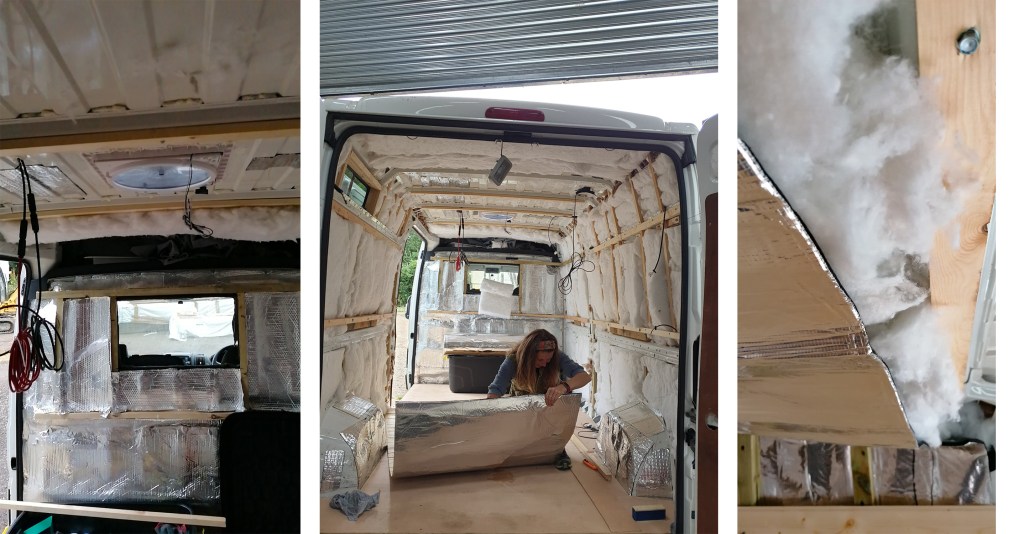
For our insulation we chose 10mm Dodo Thermal Fleece which is made from recycled plastic bottles, and then we chose to do a thermo vapour layer too. Might be overkill, we’re not sure yet. Our main reason was that if we wanted to go away in winter or to cold countries then at least we have the option without freezing.

We found the fleece really easy to work with. We applied it with a little spray glue and noticed the difference in temperature straight away whilst working in the van. The vapour layer on the other hand was okay to work with, the backing is really tar like, which I guess it needs to be. But it is definitely a two person job.

Stage 4 errors:

Double check the wiring you need, there is more than one type of 2-core!

It turns out you can’t buy everything for your van conversion from Screwfix and Wickes!

Don’t even bother with the wire clips where you need a little screw driver thing, just get yourself some of these orange clips in the image above and save yourself so much time and hassle.

Stage 5 carpet & bed frame

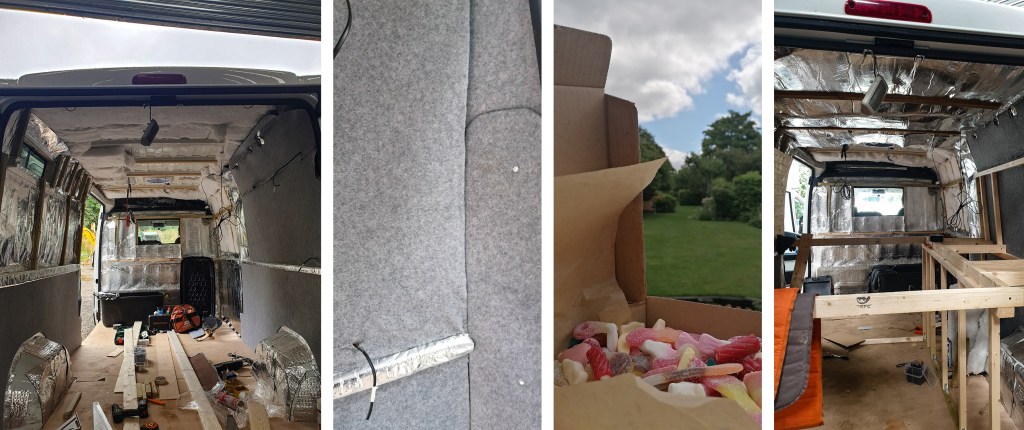
So once all the vapour layer was in we put up the 32mmx32mm battens for the cladding to screw into. We just used the vans curves to work out where was best for these.

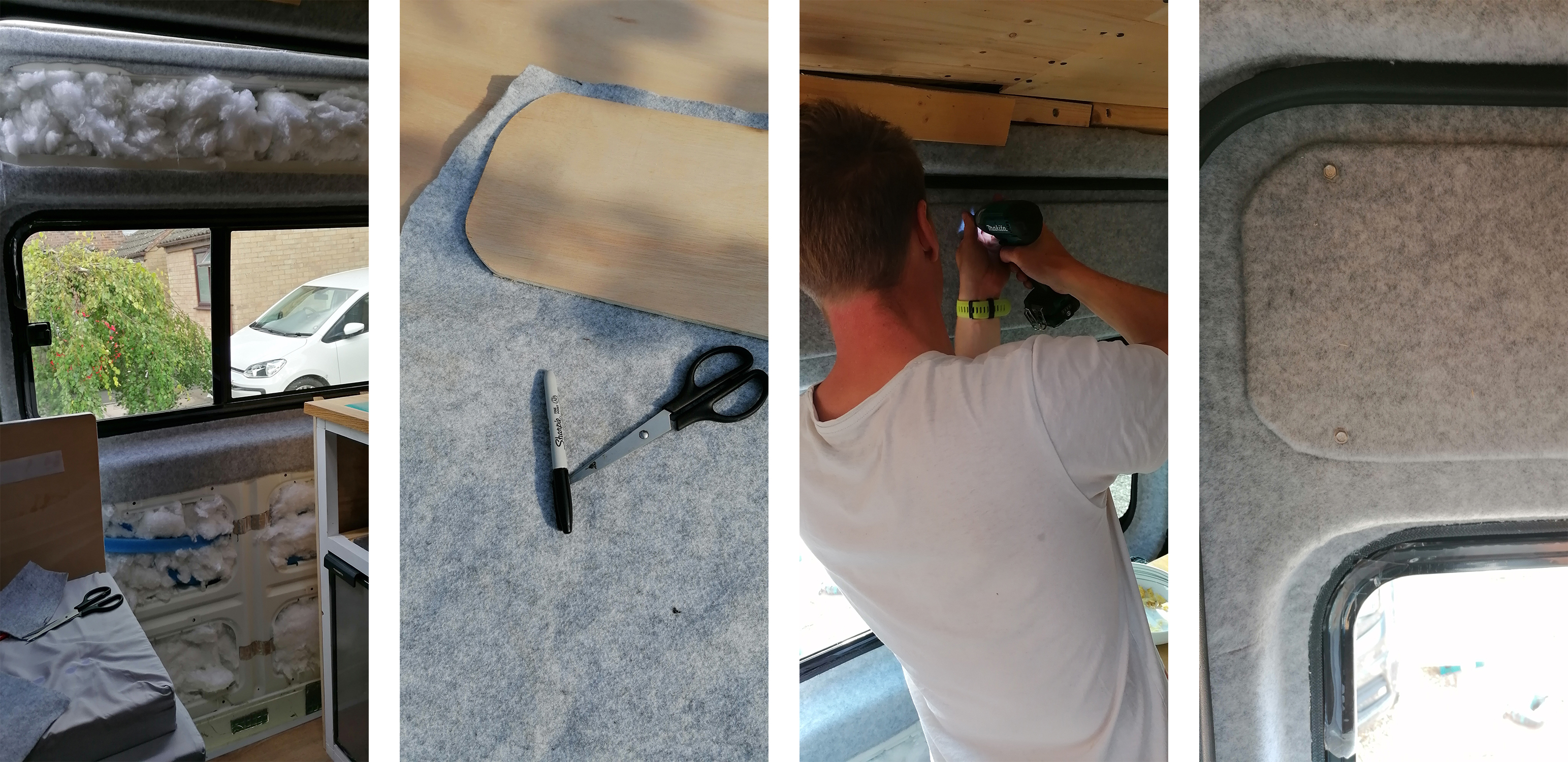
Whilst Mike did most of the battening, Holly was carpeting the 5mm ply board which is going to line the garage and the back of the wardrobe space. The carpet we used was 4 way stretch van lining.

Also, side note, if you are doing your own conversion and need a bit of a sugar rush, then you have to get a delivery (plastic free) and pick your own little bites of joy from Glossop Pick and Mix. You can thank me later.

So once the ply was in, we started building the bed frame. This was quite exciting as it was the first bit of structure which wasn’t going to be hidden. For the rectangle base we used 2×4 studwork. Then for the extra supports we used mainly 32mmx32mm battens. We made it high enough to fit a mountain bike in with the front wheels off. The bed size was based on the mattress we have which is the Outwell Dreamcatcher Double 7.5cm. So we made the frame to fit, which is 130x195cm. Whether basing our design on an inflatable mat is a good idea or not, only time will tell!

Stage 5 notes:

Looking back, make sure you take photos of where your battens are as this will be useful for future reference.

Make sure the roof battens go all the way to the end, even if this means carving them to fit the curve of the van.

We ended up buying two lots of 11m2 carpet. You will need more than you think.

Stage 6 – wardrobe & cladding

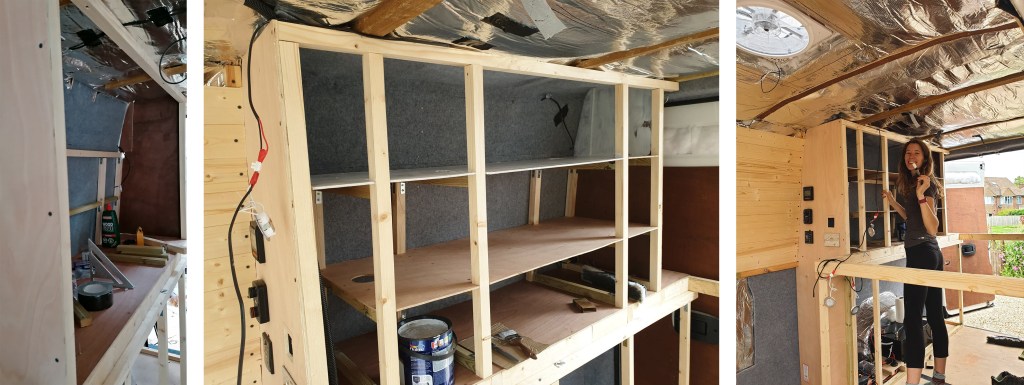
The wardrobe – Initially we made the wardrobe 35cm wide, but because of the mattress we had, we made it 40cm wide. We used 32mm battens for this and 9mm ply for the flooring of the wardrobe. Not quite sure what the finished look is going to be like but we are not carpenters so we are just doing what we can to make the most of the space, and to keep the weight down.

The wardrobe is lined with carpet and the wood is painted in an off white colour. It will do the job but now it is working out how to make it look good! Pinterest, here we come!

For the cladding we went for Wickes softwood 8x94x2400mm. We also ended up using a couple of longer 3meter packs for the ceiling. We started at the bottom side of the bed and up to the small vent window. We chose screws instead of cladding clips just for ease. It actually went in reasonably well. But you will find that you have to loosen off each piece before placing the next one in, something which we always forgot so kept screwing them down tight, before remembering we need to loosen them off again now for the next piece. Durr!!

Once we completed the side, we did the roof, this is where we had to have organised the roof light placement so we could drill the holes in the right places. After this we completed the roof. Then we did the side wall that is going to be in the kitchen area.

We have left the corner join as we haven’t worked out how to tackle this yet. We next need to clad the bulkhead and where the rest of the lights go in the roof.

Stage 6 Changes:

We would have stuck to our guns and kept the bed wider and made the wardrobe smaller.

Buy more than you think you need. You will use it and it saves you going back and forth to Wickes again and again.

Make sure you check the cladding packs for the grooves as some packs didn’t have it and therefore redundant for the task at hand and taking it back to the shop is a pain.

Stage 7 – lights & sockets

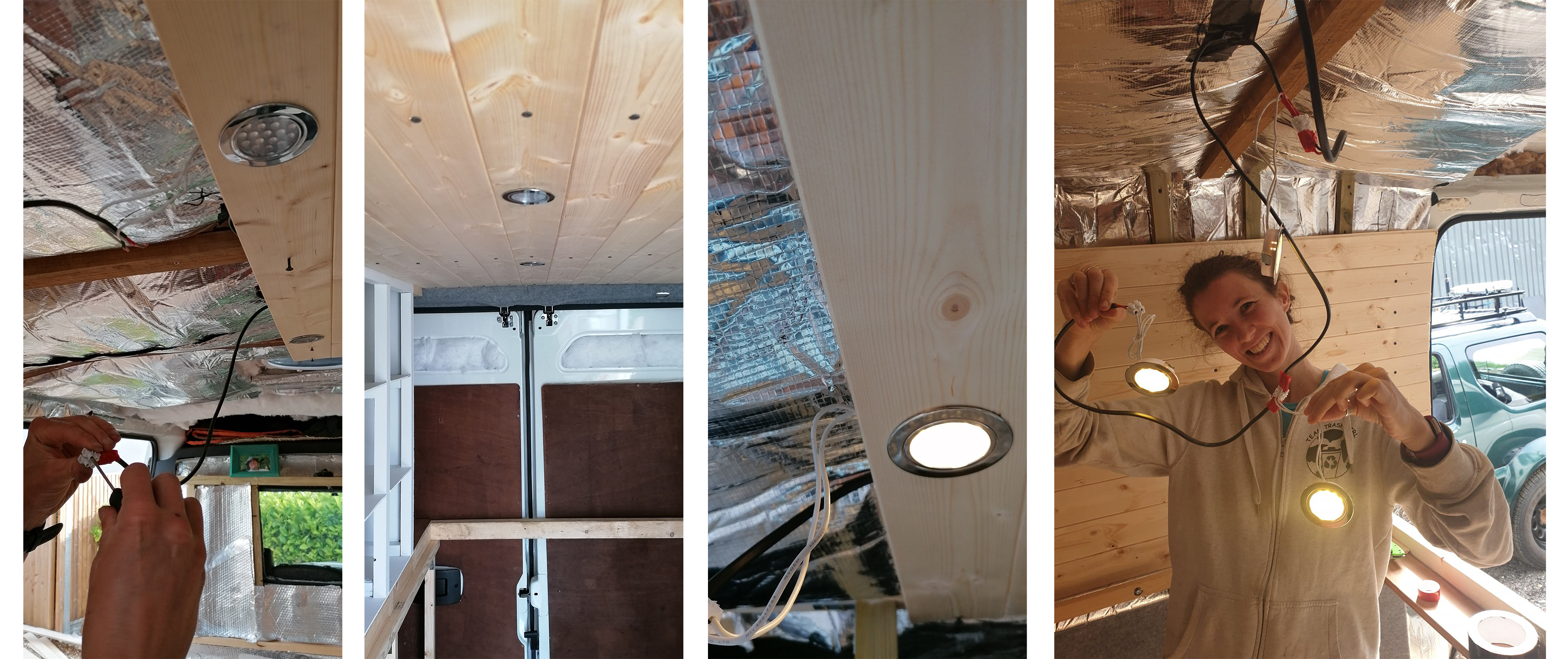
Initially we started looking at lighting styles for houses, I thought maybe they could work, but in such a small space they all would have stuck out too far, also the depth they needed behind the cladding is too deep. We only have a few cm to play with. So that idea went out the window.

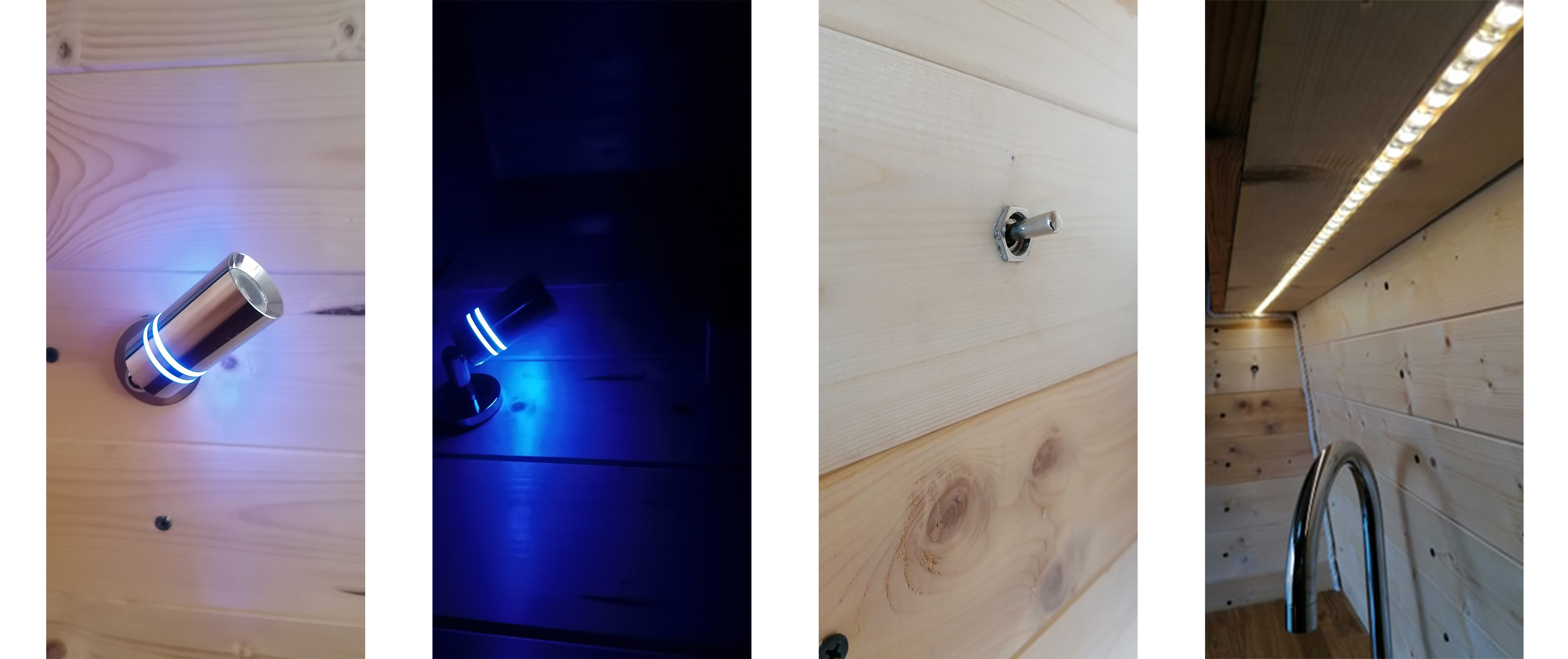
We knew we wanted touch lights and so I found these Dimatec 12v 18 LED 1.2w lights in warm white. They were perfect for what we wanted but weren’t sure how many we would actually need. I knew we needed some over the oven, and then for the bed area but for there I wanted two reading lights on the side.

We started looking on caravan and motorhome specific websites for lights, and were flooded with some really awful, plasticy designs. I was adamant we would find something that looked good. Eventually we did. They touch on and off individually but only turn off all together on the switch. We can’t work out how to make them all turn on from the switch.

I found these little beauties which are touch sensitive, they dim and they have a pretty blue light on. Perfect!

Also in the kitchen we have put in an under shelf led strip in warm white, which flicks on at the side. I love this feature and I think it looks stunning.

When it comes to sockets we wanted usb chargers for things like the speaker and phones, then the 3 prong for laptop and camera batteries from the inverter. We put these 12V/24V plug socket close to all the other appliance pieces. We then put one usb by the bed head, one by the other plug socket.

Stage 7 thoughts:

Might have gone a bit overkill with the lights, but there’s only one way to find out.

Perseverance works when looking for your perfect lights, don’t just go for the first ones you see.

Might need to add some fairy lights, but we will only be able to know where to put them once we are living in it.

Stage 8 – the bulkhead

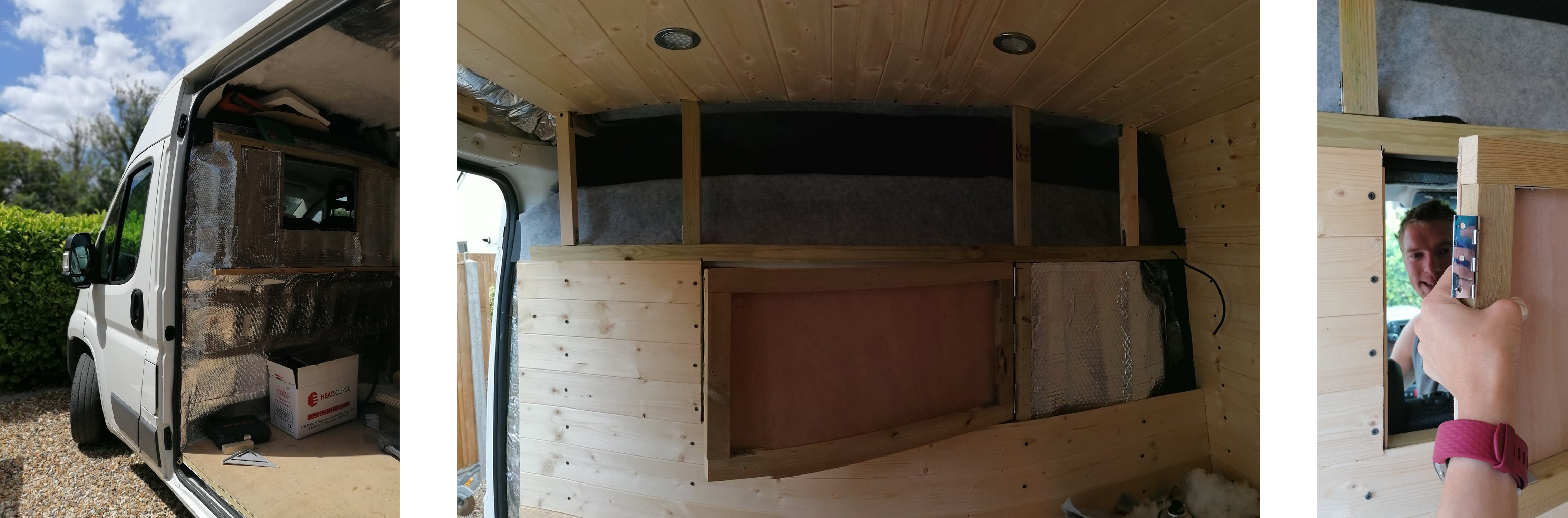
We had a couple of options when it comes to the bulkhead, remove it or clad it. We chose to clad it as that allows us to have more space in the lower part of the kitchen. (An extra 15cm or so!) We put some sound deadening sheets onto it and then carpeted the cab side and reused some old silver bubble insulation of the ‘home’ side. Then we clad and carpeted the holey bit at the top. But then we had to work on the escape hatch!

Initially we were going to put in a porthole which I really wanted however, it was too thick and was going to be too difficult so we chose to put in a hatch. I love this feature and we will be sharing all the final details like latches and curtains as and when we get to it in this blog!

Stage 8 thoughts:

If you have the carpentry skill then it would be worth taking the bulkhead out and just cladding the whole area with the angle to save space and weight.

It’s worth putting the slats in for the kitchen area at the same height at the work top so the same piece of wood can do two things.

When cutting the carpet from the cab side for the hatch, make sure to cut excess carpet so you can fold it over the sharp metal neatly. I did not allow for so much space so have had to stretch it and its not the neatest of jobs.

Stage 9 – the kitchen!

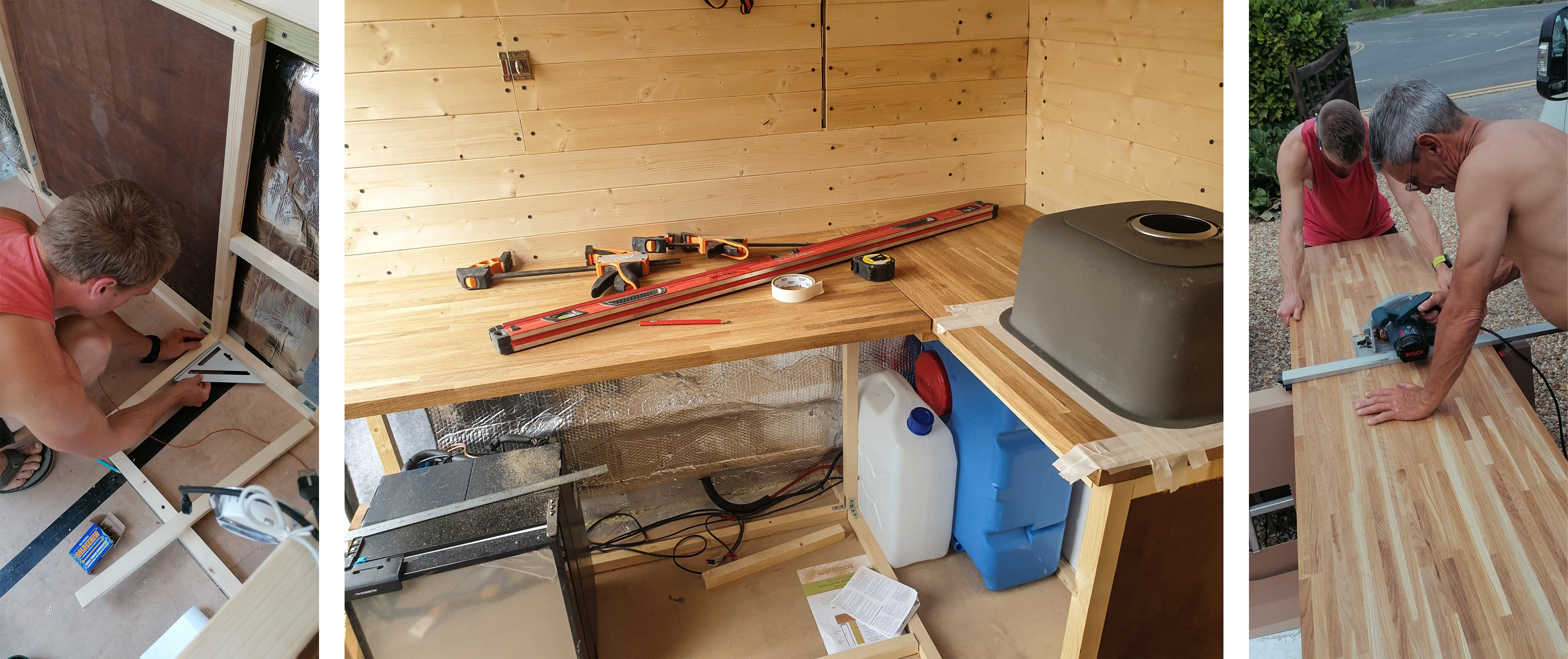
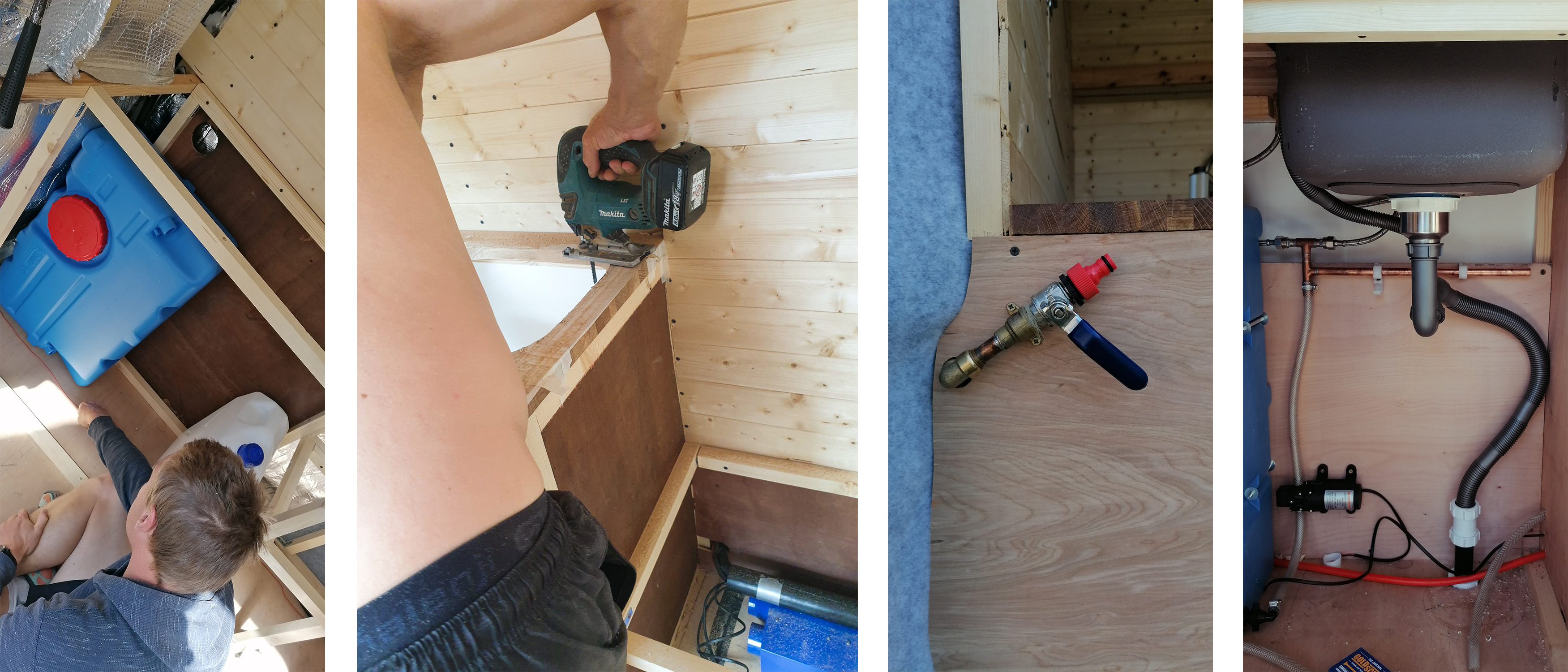
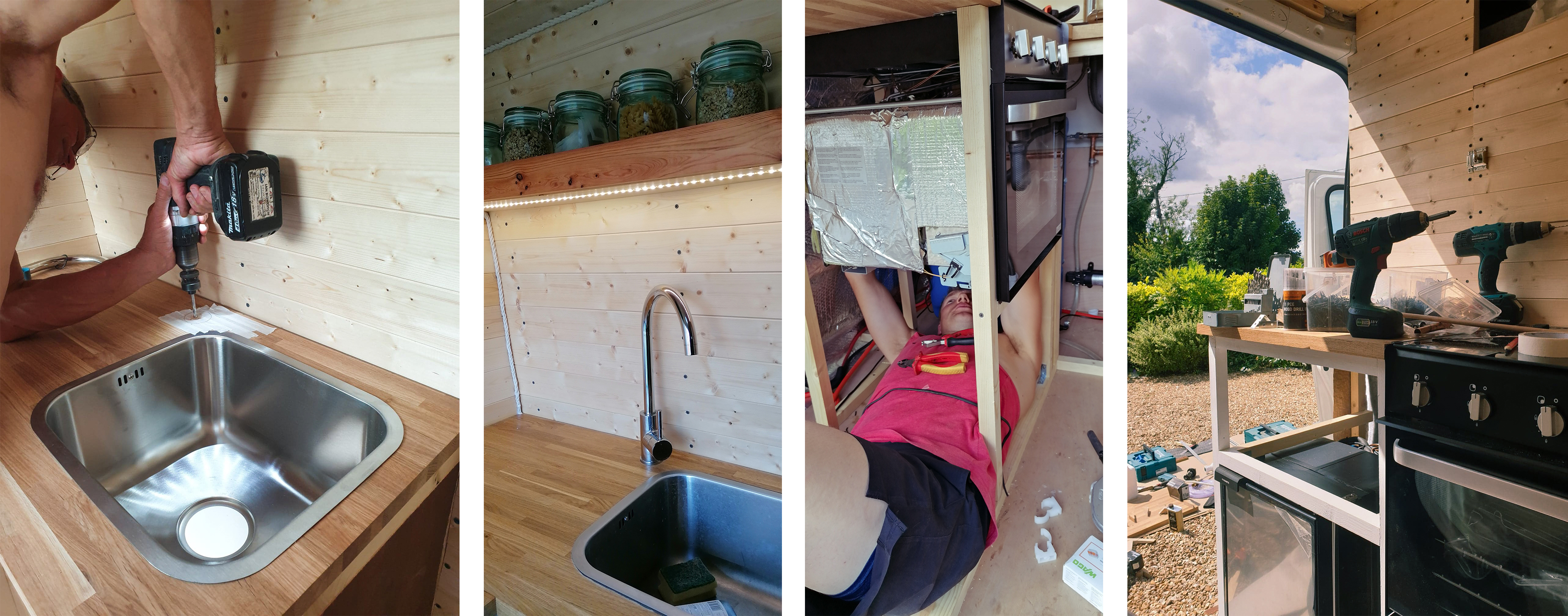
So, we built the frame from 32x32mm and loads of corner brackets. We got the Oak worktop from good old Wickes. We played around with the design quite a bit, initially the sink was by the doorway but we ended up with the fridge by the door. Ian was a great help with cutting the straight edges for the worktop and the hole for the sink. He was also great at advising us with the plumbing! We brought our undermount sink and Chrome Kalel tap from Wayfair.

The blue Fiamma water container is 70 litres (from Leisure Plus Direct as it was way cheaper than everywhere else) and we do have a backup waste one which needs to still be plumbed in. We put a tap on the edge near the side door so it is easy to fill up.

Then once the sink was sorted we put the gas oven in place and then the fridge. We chose a Dometic CRE-50 Compressor 45 litre fridge – it was the biggest we put in our budget and probably the most expensive item in the van. The oven we chose was a Thetford Spinflo Triplex LPG oven, grill and hob. I can’t wait to try baking. The Fiamma Water Expansion Tank Accumulator was also used but not in these images. Will be uploading final images in due course!

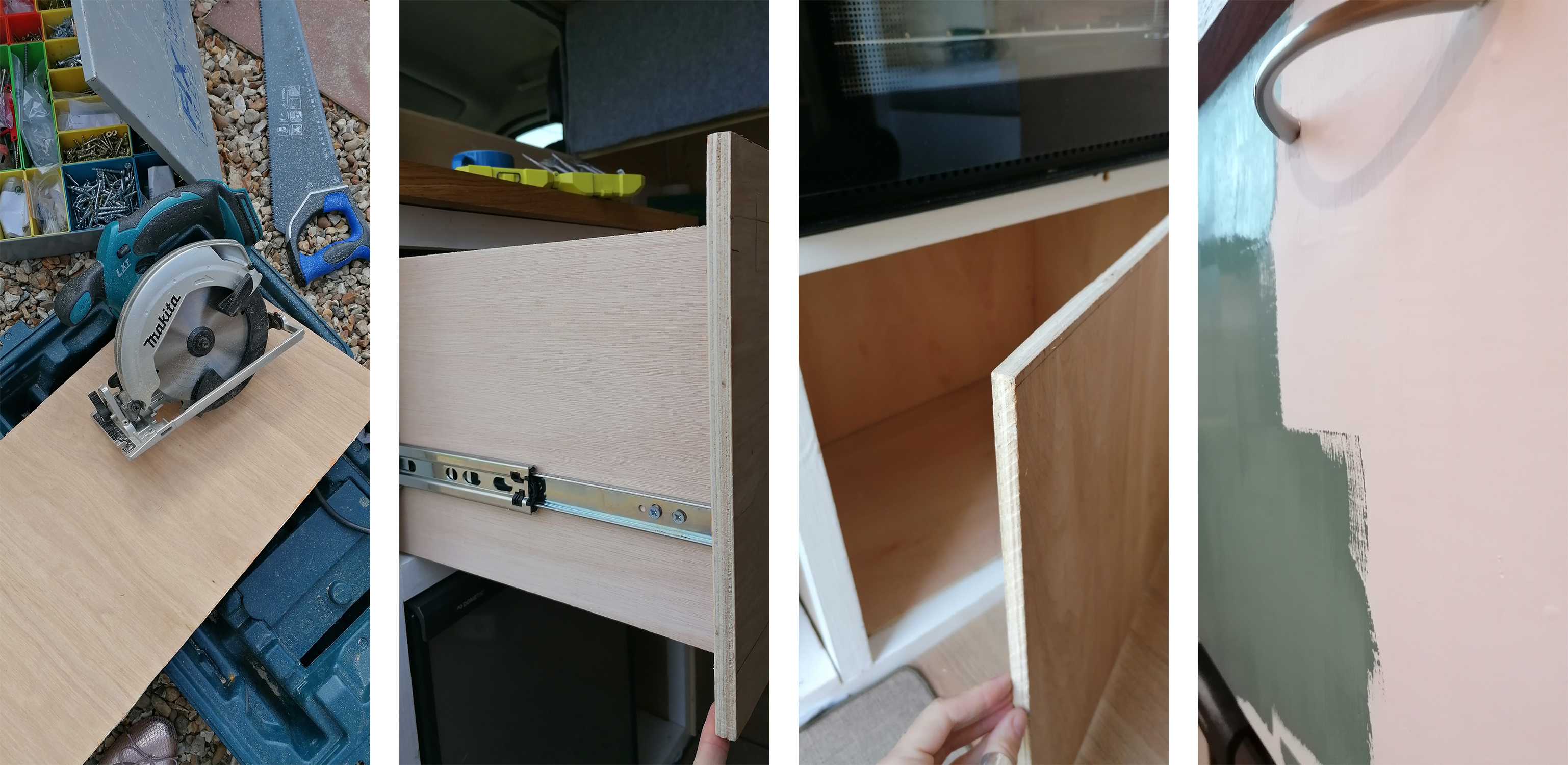
The drawers we done at a later date and we went for a mix of soft closing drawers and just plain doors. The handles we got from Wix and I had the green paint made up at Homebase. I am really happy with the overall look so far!

Stage 9 thoughts:

We would have insulated the pump against the back plywood as it is quite loud. We are going to make a box and insulate it around the pump.

This is probably where we spent most of our money so research here is key!

Stage 10 – the seating area

We decided for two chairs either side of the pull out table. Both chairs would have storage in them. The one of the left will house the gas heater and the one nearest the door will slide out so two people can sit on it if we want.

I’m really happy with this design. I wouldn’t change anything about how they turned out. Whilst here we did some other bits and pieces, like adding a side onto the wardrobe section (photo below) and adding a piece of J piping above the sliding door so the rain water wont drip into the van. It worked pretty well when we tested it with a watering can.

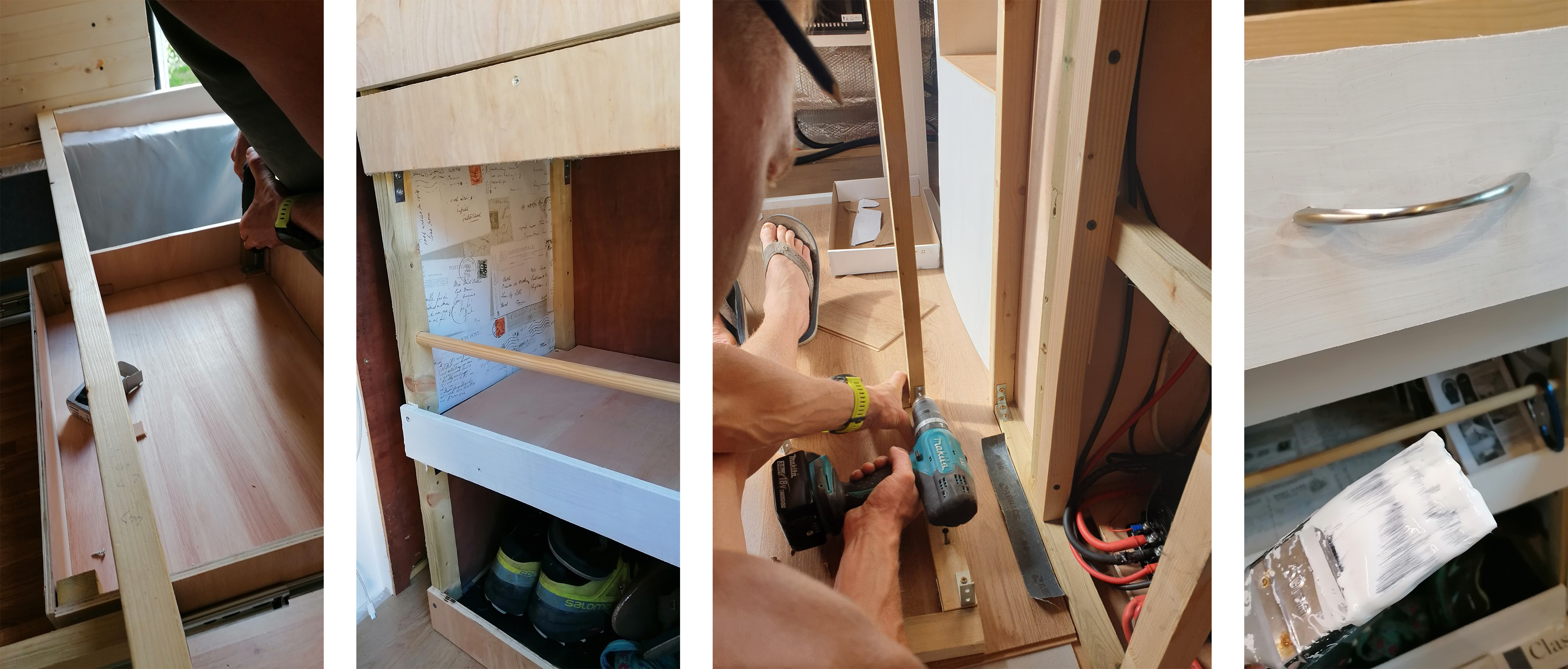
During this stage we started on the pull out table and middle storage section that is under the foot of the bed. We will have storage for shoes at the bottom, then a book shelf. Then the table and a pull out drawer on the top. These will all get painted white and lined with wallpaper I have stored which I brought for £1. It is finally starting to feel like a home!

Stage 10 Things we would change:

If we could we would have made the slide out seat on an incline so we have a bit of storage behind the back rest section, but we aren’t the best at working with angles so we decided to keep it simple.

We have a narrow gap to the left of the bookshelf so are now working out what to do with it. Probably will put a retractable tea towel rail in there for drying clothes.

Stage 11 – gas, side door & extra bits

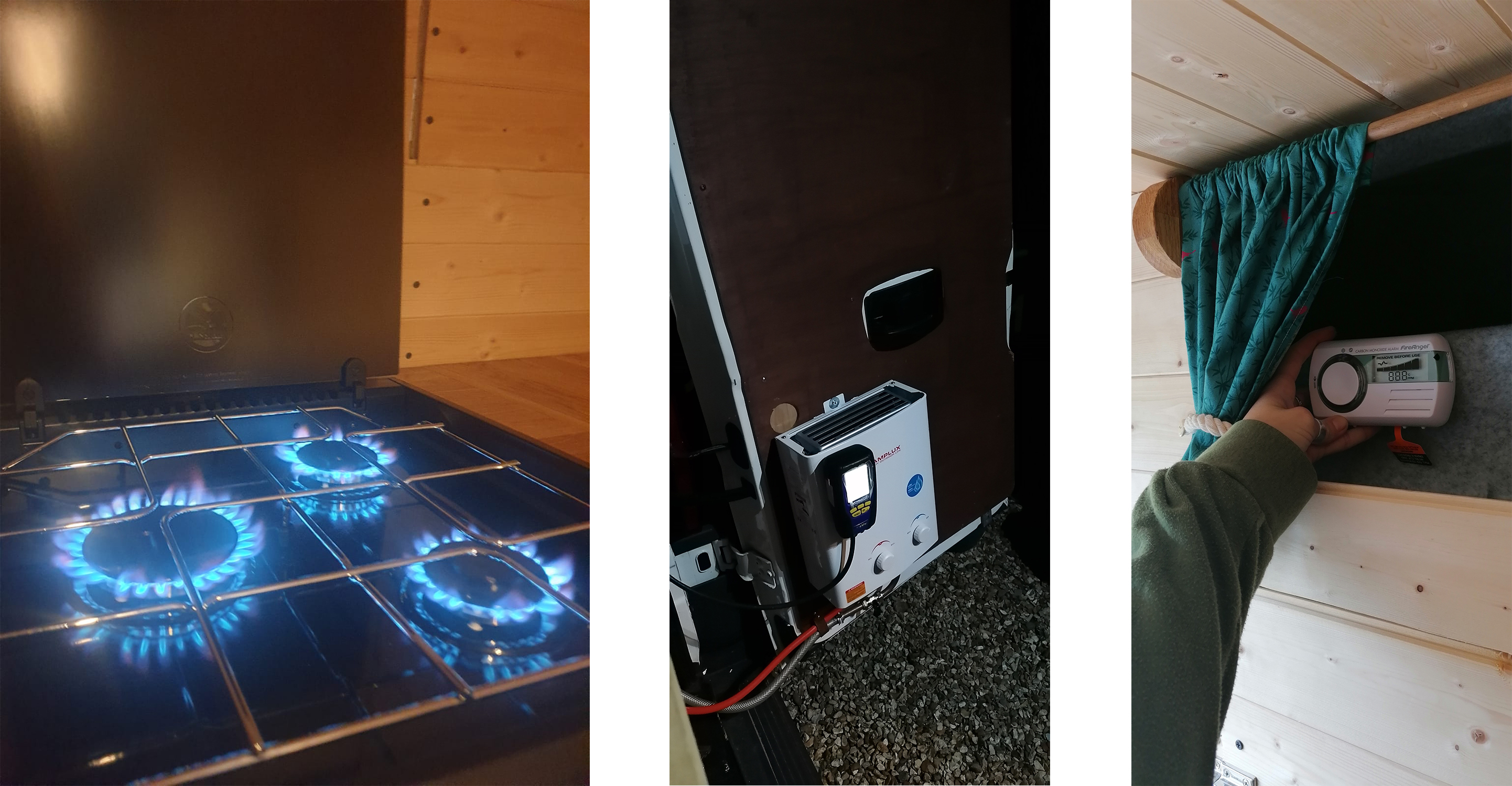
The gas is in! We have the oven, hob, shower and the heater running off the gas. We decided to go for a Gaslow refillable system which seemed like the simplest option when thinking about refilling etc. We also got the whole system tested for leaks and it was fine, plus we have fitted a carbon monoxide monitor above the stove.

Initially we were going to clad the side door but then decided against it because it would be too much weight and you never see the lower part of the door so we decided to carpet both. It looks really smart now so I am glad we did this.

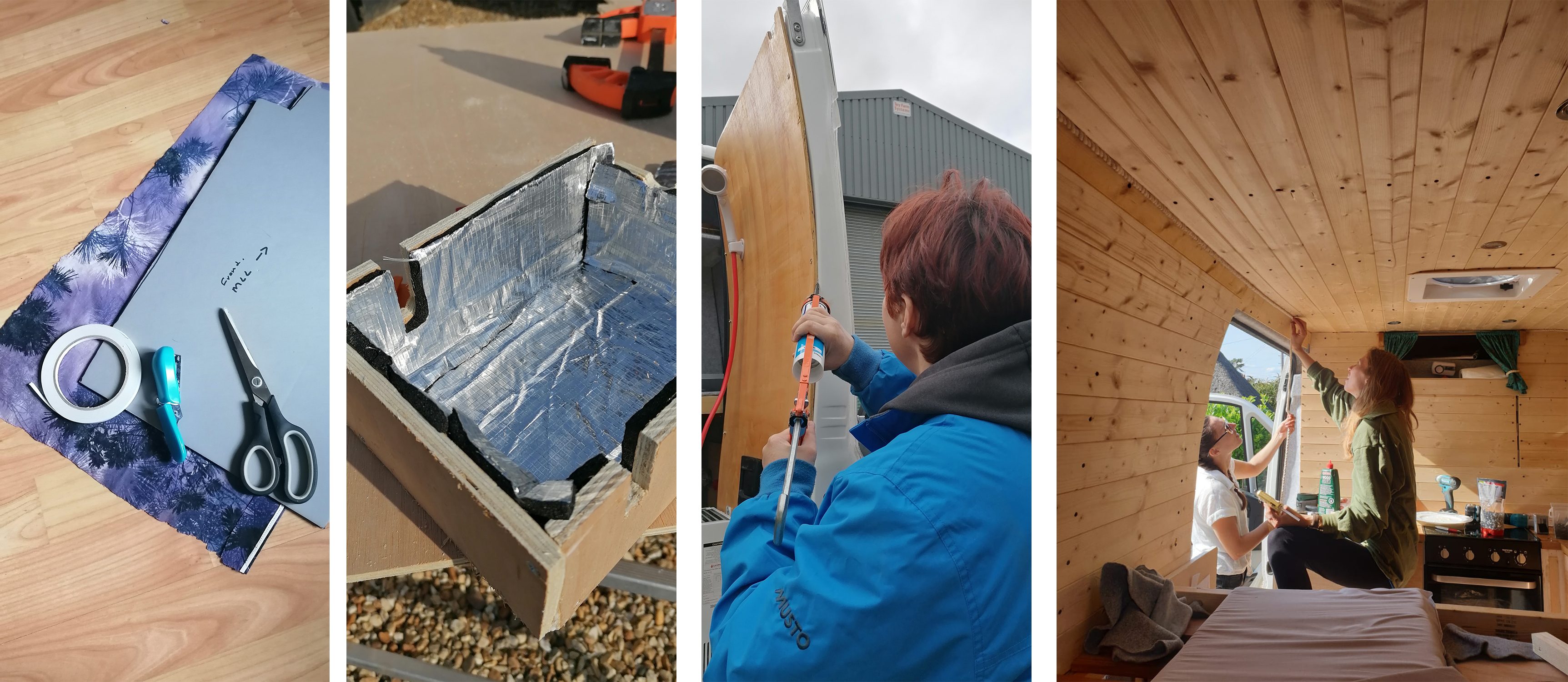
The final bits we did before my final post of the finished van includes making some dividers for our wardrobe. We made these out of cardboard foam, fabric and some double sided tape. Then we made an extra insulated box to try and quieten the sound from the water pump. It has quietened it slightly but you can still hear it.

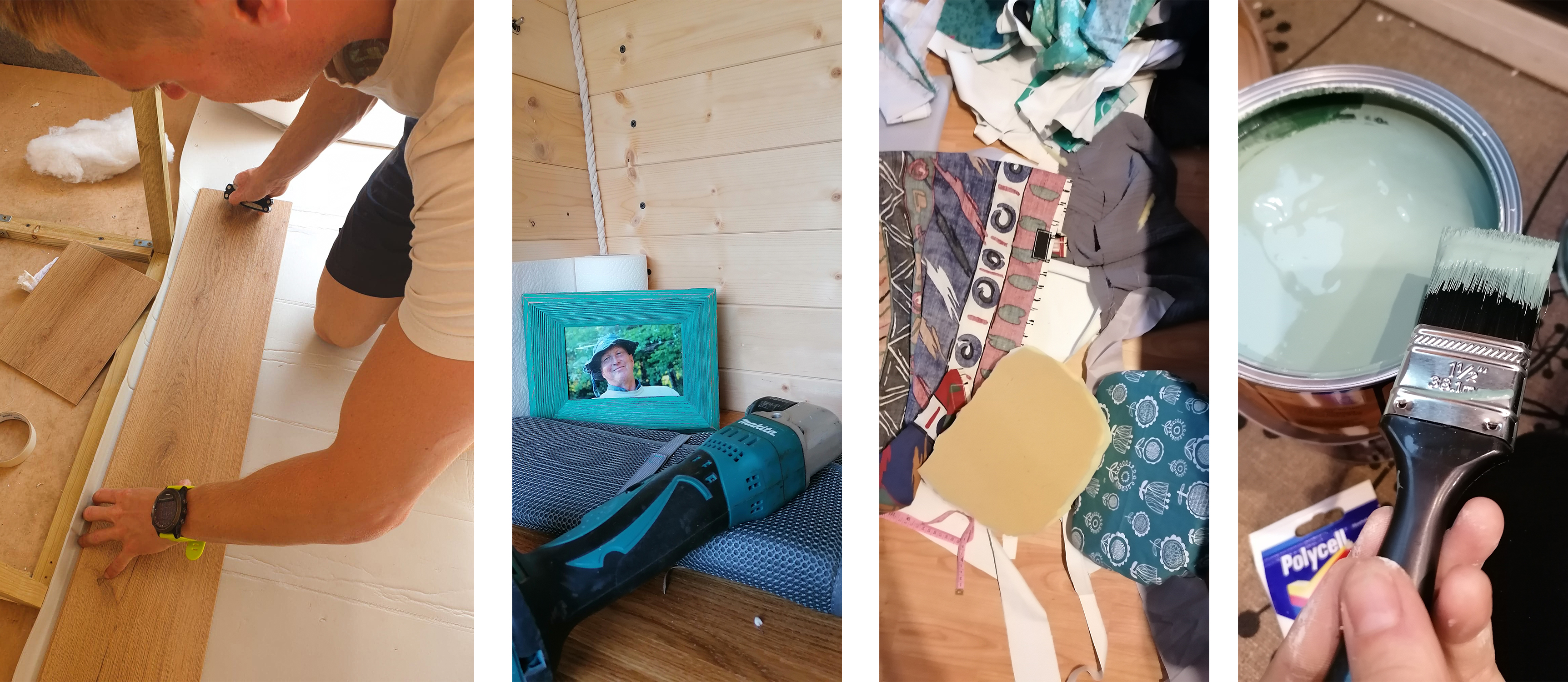
My sister then got involved and helped put sealant around the waterproofed mdf on the back doors. This is where our shower is going to be and will also get rained on so need to make sure that not water gets through to the insulation. One of the final stages is putting up the rope around the edge to finish off the van. My lovely friendly Teale helped with this step. Then finally I wanted to share a picture of my late dad who oversaw the whole build…

One of the last things we did was put the flooring in and then I made head rests for the front seats from some more remnants of material I had. I was so excited to share with you the colour that we are painting the drawers. It was one we had made from Dulex. So pleased with how it came out!

So I think this is the last blog post of construction. The next time you hear from us will be with the final images! Thanks for everyone’s support throughout the whole build and I hope this blog has helped many others on their van diy journey.

Remember to follow us on Instagram.

To view the blog about the items we recycled visit here.

To view the blog about our favourite parts of the van conversion, visit here.

This blog includes affiliate links (all genuine!)

Robens Ambassador

If I could sum myself up in a few words, I would like to think it involved the words ‘walking, filming and drinking tea’. These are a few of my passions (yes, I do enjoy tea that much…) However they delve much further than just those three things, I am passionate about connecting children with nature, I am passionate about spending time out in the woods and feeling the temperate drop before the rain comes, or the owls calling in the night to their neighbour. There are no other feelings like them. 

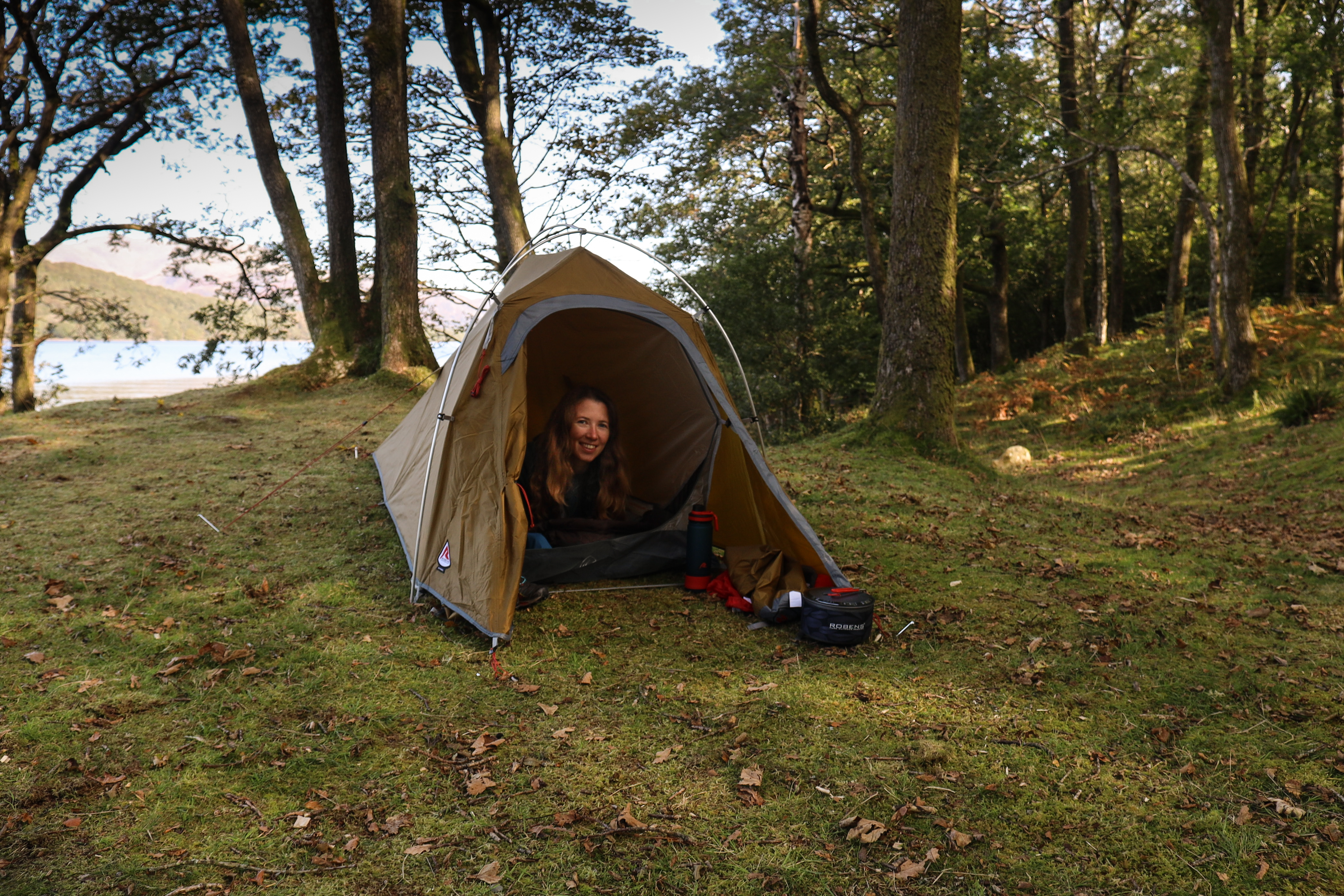
I have been hiking and camping since I could walk, maybe even before. My parents would take me up to the Lake District, one of my favourite places to visit, where I later studied a BA in Wildlife and Media at the University of Cumbria. So I guess it is understandable why I enjoy being out in the fells so much now. 

Walking is my passion, you can’t beat being out for the day walking amongst the hills, barrows, tarns and woodlands, actually, you can beat that, you could be out for the day and night! Wild camping is also something that I enjoy. I guess that is what led me to help develop Julia Bradbury’s online website The Outdoor Guide. I have made some great friends and been introduced to some wonderful brands; one of my favourite has to be Robens.

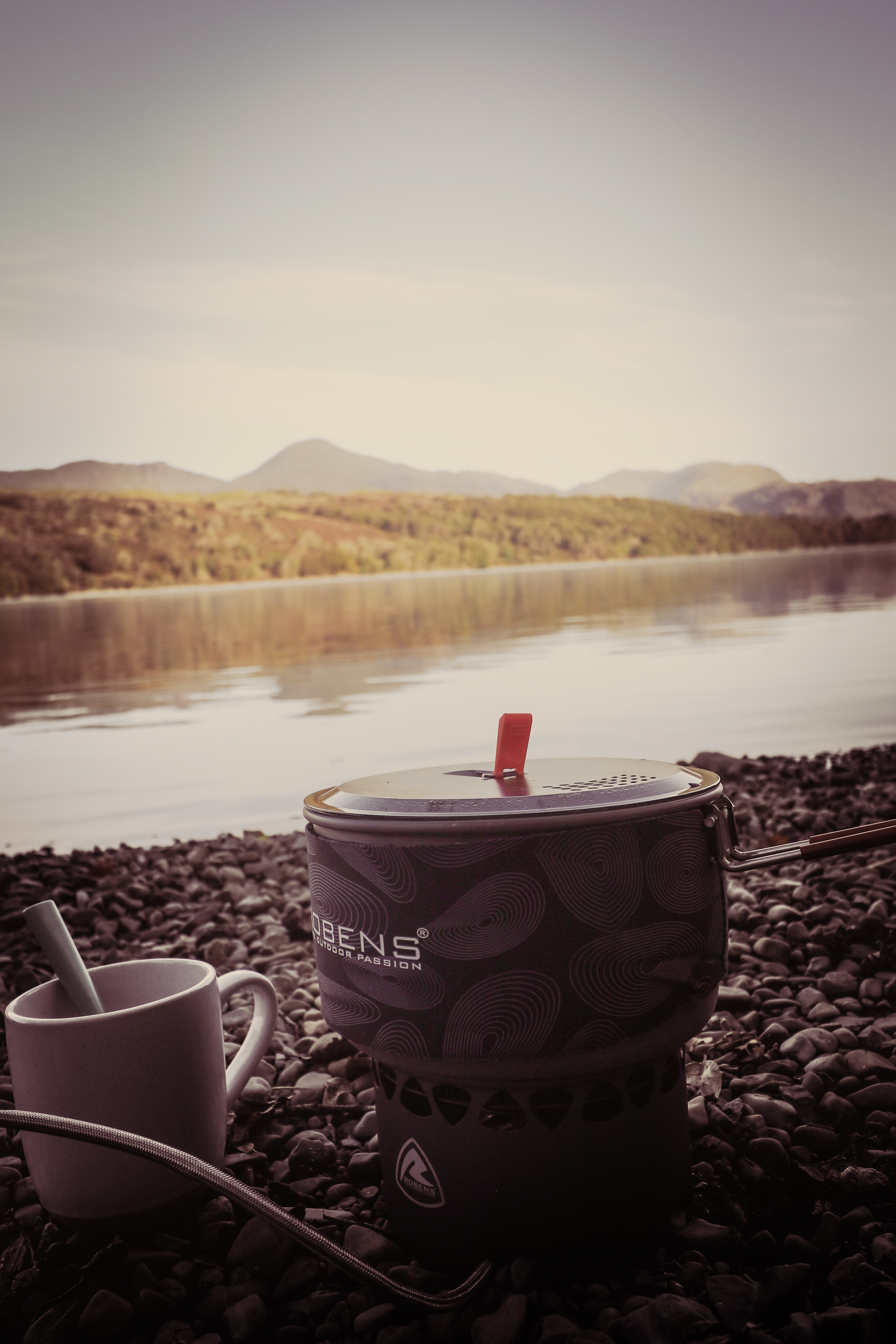
Robens is part of the Oase Outdoors family-run Danish company that designs camping gear for people who love real adventure. It was created over 45 years ago and they continue to provide high quality gear that looks great and can put up with demanding use. 

I’ve been to the Roben’s HQ (video below) a couple of times now and the whole team are actual outdoorsy people who go camping and hiking in all weathers and seasons, so they know what to look for when designing outdoor gear. 

I am proud to announce that I am a Robens Ambassador, this stems from a relationship which has blossomed from our shared love of the outdoors. This is not a paid partnership, the gear has been gifted and all my views are honest. As much as I would like to share some great wild camping videos with fantastic backdrops, Coronavirus lockdown has kept me in the garden. So I will be sharing some ‘Garden Camping’ videos over the next few months.

Up first, you can see me pitching Roben’s Challenger 2, followed by a 5 minute yoga session: 

For 2021 the showroom was held in the UK so the 2021 range of gear video can be seen here:

Please follow myself and Robens on instagram to keep up to date with competitions, news and videos. If you have any questions please shout!